

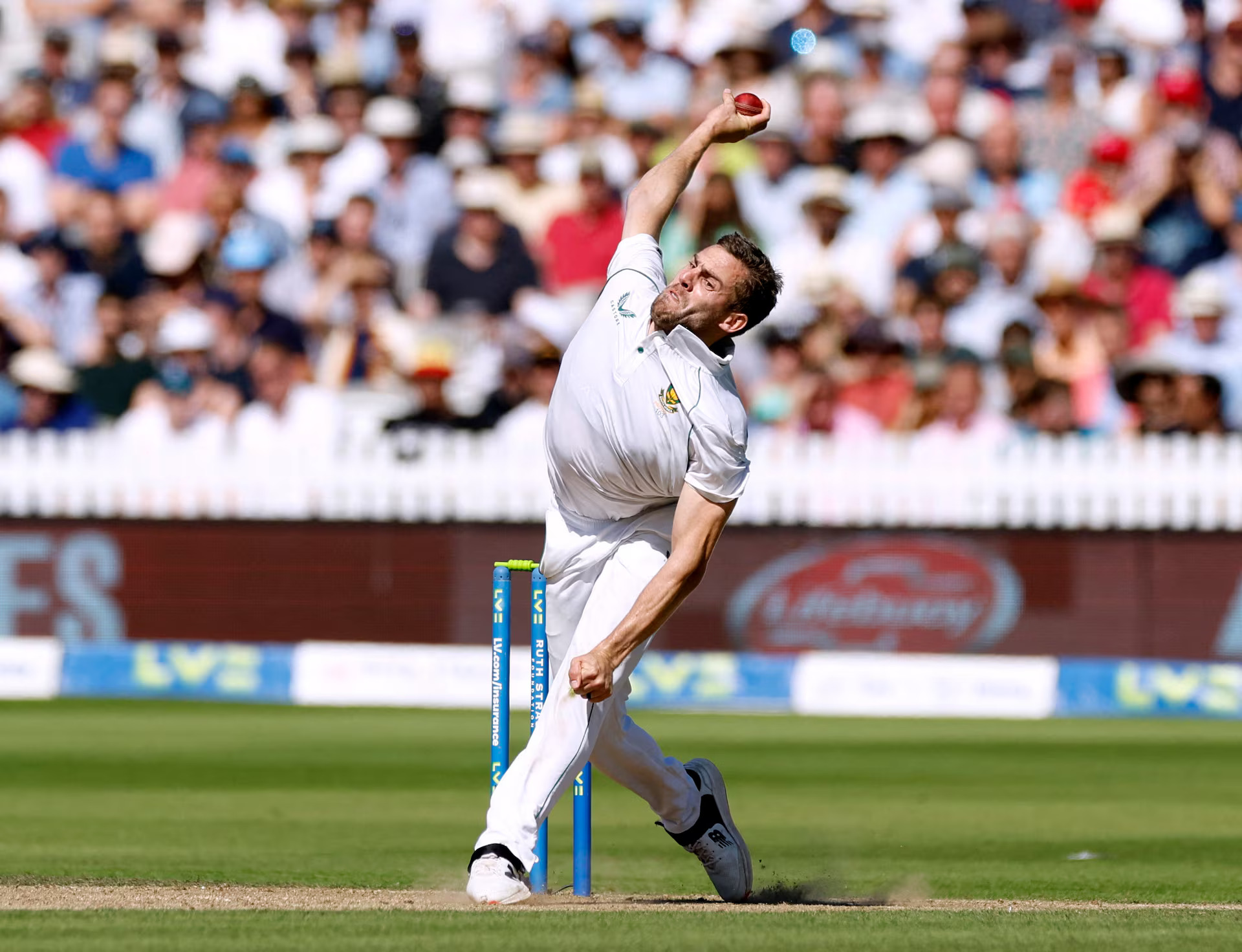
It’s not every day a bowler beats Virat Kohli on the inside edge by a distance equal to the width of another bat face. When Anrich Nortje blew the then Indian captain’s front pad off in Ranchi to claim his first Test wicket, the fast-bowling connoisseurs had a dream. Here was a fast bowler in the truest sense of the term, with the pace to potentially take world cricket by storm. Seven years on, that promise had receded till Nortje was called out of the blue for a Test comeback, in what would only be his 20th game in the longest format.
Nortje had gone wicketless in his first Test in Pune, dismissing Kohli only in the third innings of his career. In Durban, returning after nearly four years away from red-ball cricket, it took him less than two overs to look at home again. Marnus Labuschagne was jumping around; Steve Smith was hanging his bat outside off stump, fortunate not to edge behind. Nortje was consistently pushing beyond 145 kph, bringing back a glimpse of the threat that had made him such an exciting prospect.
Rhythm is an intangible quality that often defines a fast bowler’s performance. A quick returning after nearly four years away from the format is an occasion when it is not expected to be in abundant supply, particularly when injuries have interrupted his career. Yet Nortje appeared to find his almost immediately after being introduced into the attack.
His return, however, had come under unusual circumstances, with South Africa losing Kagiso Rabada, Lungi Ngidi and Kwena Maphaka to injuries ahead of the series. Suddenly, Nortje went from being a specialist in white-ball cricket to being one of the two frontline seamers in a Test attack against Australia. How had he spent the intervening years, what had he done to prepare for this return, and what did South Africa believe he could offer that they could not find elsewhere?

Nortje’s last Test appearance before his latest came in the first match of the two-game home series against the West Indies in March 2023, where he took a five-wicket haul. A groin injury ruled him out of the second Test, which saw Temba Bavuma register a century after 88 innings, the second-longest gap between Test tons ever. From thereon began Nortje’s unfortunate tryst with injuries that would limit his potential to a fraction of what it might have been. A lower back stress fracture ruled him out of the 2023 World Cup in India, the 2024 season of the SA20, and two high-ticket Test series: against India at home and against New Zealand away.
The road back began in March 2024, when Nortje returned to competitive cricket through the CSA T20 Challenge for the Warriors. Three appearances later, he was on a flight to India for the IPL, where he turned out for Delhi Capitals. The numbers were far from flattering: seven wickets in six matches at an average of 42, conceding 13.36 runs an over. But the mental and physical toll injuries take on sportspersons is such that a bowler who was leading the T20 bowling economy rate charts not long ago was happy with merely getting back on the park to begin with. “It was about finding ways to get better over there,” Nortje told cricinfo on the sidelines of the 2024 T20 World Cup about his time in the IPL. “And the training after the games was good, working with the coaches there at Delhi, with James Hopes. I wasn’t worried much about what the scoreboard did at that stage.”
The recovery also prompted a rethink of how he wanted to navigate international cricket. By March 2024, Nortje declined a central contract offer from Cricket South Africa for the upcoming season, aiming to secure greater autonomy over his physical strain and schedule across formats. Having gone more than a decade without a stress fracture before the latest episode, he admitted to feeling “a little bit of ‘nervy’ in the back”. The freedom to take a week off, or even a month, if necessary, offered what he described as “calmness”. For a fast bowler whose career had repeatedly been interrupted by injury, control over when to stop had become almost as important as knowing when to start.
This meant Nortje let go of each of the four Test series South Africa played in quick succession later that season, and wasn’t part of the team that beat Australia in the WTC final at Lord’s. In fact, domestic red-ball appearances also came to a halt. But recovery wasn’t linear. A toe fracture in late 2024 and another back injury in early 2025 meant Nortje hadn’t featured in a single international fixture across formats after the 2024 T20 World Cup final. When head coach Shukri Conrad said South Africa were “definitely not drawing a line through his name” in mid-2025, the reassurance carried an implicit acknowledgement of how uncertain Nortje’s future had become. The question was no longer simply when he would return, but how many times he could be expected to do so.

The initial competitive cricket Nortje played after featuring twice in IPL 2025 came in the CSA T20 Challenge that November, where he gave a good enough account of his fitness for South Africa selectors to draft him into the squad for the T20I series in India in December. The return wasn’t spectacular: his first three T20Is saw him concede 114 runs in 10 overs without picking up a single wicket, but the experience and trust he had built over the years with his raw skills and the ability to execute them under pressure ensured that he got a seat in the squad for the 2026 T20 World Cup in India regardless. Conditions and combinations meant he could feature in the XI only twice in the tournament despite decent returns of 3-57 across the two games.
Yet the road back to Test cricket had been taking shape away from the spotlight. Nortje had played just one IPL match in 2026 before turning out for Rotterdam Dockers in the European T20 Premier League, leaving little evidence in his match schedule of a conventional route back to the longest format. There had been no sustained run of first-class cricket to test his readiness over long spells. The most overs Nortje had bowled in any recorded cricket game since April 2023 was five. Instead, the preparation was happening largely behind the scenes.
“My prep from quite some time back has been red-ball,” Nortje said ahead of the Australia series. The focus, he explained, was on rebuilding his workload gradually and in the right way, while working to execute his skills with the red ball and increase the number of overs he could bowl. He was also reviewing his action, looking for improvements in his alignment and mechanics that could make it “stronger, more sustainable and more reliable”. Working with national bowling coach Piet Botha, he had been filming his own sessions and analysing the footage. The objective was not simply to return to the pace that had once made him so threatening, but to build a method his body could withstand.
The changes were more fundamental than a few technical adjustments might suggest. Nortje did not want simply to return to the action he had used before Covid and allow old muscle memory to take over. In his own words, he had altered the angles of his run-up and jump, as well as the flow of his bowling arm. The action might have looked almost identical to an outside observer, but it felt different to him.
“It didn’t feel right, it didn’t feel like there was power behind it,” he said of the earlier mechanics. The rebuild was an attempt to restore that feeling of power without returning to the same physical demands that had contributed to his troubles. Nortje was not chasing his old self so much as trying to build a version of himself that could endure.

The opportunity arrived as South Africa’s fast-bowling resources were stretched. Ngidi and Maphaka were ruled out of the Australia series with hamstring injuries, while Rabada’s participation was uncertain after he suffered a similar problem. Rabada was named in the preliminary squad, but his fitness remained a concern as the first Test approached. Nortje, alongside Coetzee and Paterson, was brought back into the wider group.
There was an element of circumstance to the recall, then, but it would be reductive to describe it as a desperate call for an available fast bowler. Nortje had been working towards this possibility long before the injuries created a vacancy. At 32, with 19 Tests and 70 wickets behind him, he was not an unknown quantity being asked to discover whether he could bowl in the format. He was a proven Test bowler trying to establish whether his body could still accommodate the demands of being one.
Stepping back onto the field in South Africa’s Test whites held a distinct emotional resonance for Nortje, a feeling his time in limited-overs cricket had never fully matched. He admitted to feeling “goosebumps” at the mere thought of a comeback, reflecting on how his baggy green-and-gold cap had spent years sitting idle in his house instead of being handed over to the umpire. The draw was far greater than simply letting rip against the Australians at high speed; it offered a path back to the arena he had always dreamed of dominating, providing the ultimate test of whether his painstaking behind-the-scenes adjustments would hold up under long-format strain. And, initially, they did.
On a Kingsmead surface offering turn from the centre of the wicket in the first session, South Africa had taken a calculated risk by going in with only three frontline quicks, one of whom was an all-rounder and another who had not played a Test in nearly four years. Nortje needed less than two overs to make the gamble look worthwhile. A delivery hurried Labuschagne into taking evasive action, striking him on the midriff; another, seaming away late, beat Smith’s outside edge. The pace was familiar. So, too, was the unsettling effect it had on batters who had little time to adjust.

But the more revealing signs of Nortje’s return lay beyond those early moments of hostility. Across his opening five-over spell, his line remained remarkably consistent, while subtle changes in length kept the batters from settling into a predictable rhythm. He tested the front foot with a fuller delivery, pulled the length back just enough to make the same forward movement uncomfortable, and delivered the occasional vicious bouncer that had the Australian pair hurrying. In fact, a concussion meant Smith the crazy catcher was missing in action during the South African pursuit. These were not merely the instincts of a fast bowler letting the ball go; they were the decisions of one working through a batter, using pace as a means rather than an end.
After years of T20 cricket, Nortje could reasonably have been expected to suffer from the consequences of the patterns – or lack thereof – that format repeatedly demands: the yorker at the death, the disguised slower ball, the change of pace designed to disrupt a batter’s timing — constant variation, in essence. Yet there was little in his opening spell to suggest that these habits had displaced the disciplines of red-ball bowling. T20 cricket rewards the ability to disrupt a batter’s plans in a handful of deliveries; Test cricket demands the patience to keep asking questions until the batter makes a mistake. Nortje’s first spell suggested that the intervening years had not eroded that understanding. His rhythm had returned almost immediately, but it was the control beneath it that offered the more encouraging sign.
Having already bowled as many overs in the first spell as he had in any competitive game of cricket in the last three and a half years, Nortje’s real test of durability lay in what followed. His second spell began after a gap of 13 overs on the other side of the lunch break. After beginning with a loose half-volley, he pulled his length back, moving the ball away from the two left-handers, Matt Renshaw and Alex Carey, and beating their outside edges twice in his first over. The pace was up in the mid to high 140s as he challenged the southpaws to eke out every bit of survival instinct they possessed as Test match batters.
Then came the breakthrough. In his fifth over of the spell, Nortje induced Carey into driving at a full delivery without allowing the wicketkeeper to get close to the pitch of the ball. The thick outside edge flew to Aiden Markram at second slip. It was Nortje’s first Test wicket in nearly four years, off his 58th ball of the match, delivered at 143 kph. Two deliveries later, Beau Webster edged a near-perfect length ball in the channel that held its line. Nortje later revealed a joke that Aiden Markram keeps telling him about his bowling: “You bowl for long spells, you don’t get wickets, then you get two quick ones.” The remark carried a hint of the paradox of fast bowling. The work of a spell can seem unrewarded until a couple of deliveries change its entire complexion.
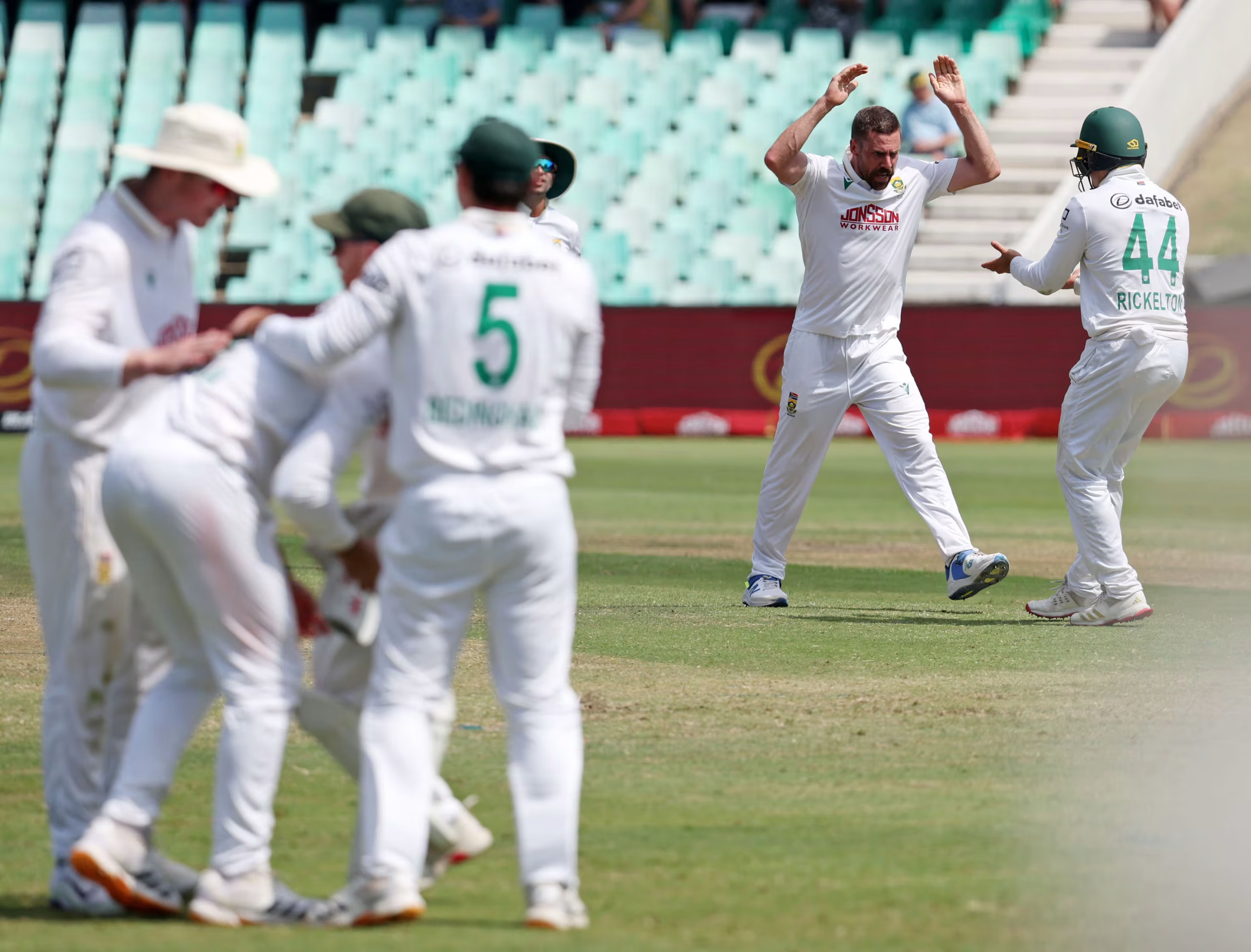
Taking the ball off the hands of a fast bowler who has just picked up two wickets in an over and is breathing fire is almost akin to committing a crime. A crime which Bavuma did not commit, giving Nortje a sixth over in his second spell. And if, along with momentum, he had some luck going his way, the Durban Test might well have shaped up very differently. From around the wicket, Nortje got Renshaw to edge a rising ball in the channel that fell short of the slips. Had it gone to hand, Australia would have slipped to 125-7 with no recognised batter remaining. As it turned out, Renshaw dug in to turn the visitors’ fortunes around and made a career-best 190, shepherding the tail expertly. Nortje had done enough to put South Africa in a position to take control; he could not, on his own, ensure that they did.
The shift in momentum became more apparent as Australia recovered. Nortje returned for a third spell late on day one, conceding three boundaries in 2.2 overs before bad light stopped play. He strayed down the leg side more than once, a contrast to the precision of his earlier spells. Returning the following morning to complete the spell, he conceded 29 runs across six overs.
The change was not necessarily proof of physical fatigue, but it offered an indication of how demanding the format could be. Nortje had shown that he could recover his rhythm and produce two incisive spells; the challenge was maintaining the same precision as the innings wore on. Renshaw, in particular, appeared increasingly comfortable against him. The Australian left-hander even faced all 24 deliveries of Nortje’s fourth spell without allowing Nathan Lyon to face a single ball.
The rest of South Africa’s attack struggled to arrest Australia’s recovery as the tail continued to wag. Perhaps the hosts’ biggest disappointment was the limited impact of their spinners. Simon Harmer and Keshav Maharaj found assistance from a Kingsmead surface with a history of offering turn, but could manage only one wicket between them in 48.2 overs, conceding 143 runs. That wicket, Renshaw’s, came only when the Australian opener was finally exhausted at the end of a monumental innings.

South Africa had allowed Australia to turn 125-6 into 390, surrendering a position from which they might reasonably have expected to take control. In some ways, the first innings reflected Nortje’s own experience: an imposing start followed by a gradual shift in the balance of the contest. While his influence waned after those first two incisive spells, Nortje never looked entirely out of sorts. He bowled 28 overs, the joint-most he had managed in a first-class innings, conceding 88 runs at 3.14 an over. For a bowler returning to Test cricket after nearly four years away, the workload was significant in itself.
Nortje later admitted that he had tried to simulate the demands of a long spell in the nets, but, he also acknowledged, “it’s never the same, you can’t simulate it as much.” There were stages when he was “out of breath”, although he was quick to point out that Durban’s conditions had left the other bowlers feeling similarly, quickly dissipating any self-doubts that might have arisen regarding his fitness.
What was striking, however, was that Nortje did not speak of the longer spells as something to be endured reluctantly. “I enjoy the hard graft,” he said. “I have always said it, that the second, third, maybe the fourth spell is the point in the game that I enjoy the most, where you have to try and dig deep and try and get something out for the team.”
That enthusiasm offers a useful counterpoint to a career increasingly defined by questions of physical management. Nortje had deliberately changed his action to make it more sustainable and taken control of his schedule to avoid pushing his body beyond its limits. Yet the demands that might appear most daunting from the outside – the repeated spells and the need to dig deep when a batter refuses to yield – were precisely the parts of Test cricket he said he enjoyed most.
A comeback measured only by wickets would miss the significance of his ability to bowl 28 overs in an innings and 40 in a match; one measured only by overs completed would ignore how his effectiveness changed as Australia’s batters adapted.
𝗕𝗥𝗘𝗔𝗞𝗜𝗡𝗚 𝗡𝗘𝗪𝗦:
The Proteas have made one change to the squad, with Matthew Breetzke replacing Tristan Stubbs 🔄Ryan Rickelton will take over the wicketkeeping duties for the second Test 🇿🇦
#SSCricket #SAvAUS https://t.co/n9OTkO1bxI
— SuperSport 🏆 (@SuperSportTV) October 15, 2026
Australia began their second innings with a lead of 106, and with the opportunity to dictate the terms of the match, they wasted little time in pressing home their advantage. Renshaw added 82 to his first-innings 190, while Nic Maddinson provided a brisk 48 off 38 balls. Australia declared at 314-6 after 58 overs, leaving South Africa a target of 421.
Nortje, though, had a few reminders of his own to offer. Maddinson was teeing off when Nortje fired in a searing yorker that beat him for pace and ended an innings that had threatened to take the game further away from South Africa. It painted the latest version of one of the most primal sights in cricket: stumps flying all over the place. He also cleaned up Carey later in the innings and let out a guttural roar, the kind emblematic of fast bowlers of his kind, signaling just how much every wicket meant to him, even if the game looked like it was slipping away. His innings finished with 2-56, taking his match tally to four wickets.
South Africa’s response offered little prospect of a turnaround. Aiden Markram fought for 75 and David Bedingham made 46, but the hosts were dismissed for 206, losing by 214 runs. The defeat was not Nortje’s to own. South Africa had let Australia recover from 124-6 in the first innings, then failed to build a meaningful response with the bat. His second-innings wickets could not undo the damage already done.
That leaves a question bigger than whether Nortje has earned another cap. Rabada is in contention to return for the second Test in Gqeberha after missing Durban with a hamstring injury, while Ngidi and Maphaka were also ruled out of the series opener as they continued their rehabilitation. The circumstances that opened the door for Nortje are changing, and South Africa’s selectors will soon have to decide whether his performance has done enough to keep him in an attack returning to fuller strength. Making a case for selection and making himself undroppable, however, are two very different things.
The more difficult question is what role South Africa can realistically build around him. Nortje offers something few bowlers can replicate: genuine, sustained pace, the ability to unsettle a settled batter, and the threat of a wicket even when a spell appears to be going nowhere. But should the selectors plan around him as a regular fixture across Test series, with all the workload that entails, or treat him as a high-impact option whose use depends on his fitness, preparation and the conditions? His injury history makes it difficult to assume he can be relied upon indefinitely; his performance in Durban makes it equally difficult to dismiss him as merely a stopgap.

Nortje’s dilemma is not an unfamiliar one in international cricket. Fast bowlers have always walked a fine line between pushing their bodies to the limit and preserving them for the long haul, but the demands of a crowded international calendar have made that balance harder to strike. For some, the route back to Test cricket has involved years away from the format; for others, repeated injuries have made every comeback an exercise in uncertainty. Their experiences offer useful context for what South Africa might expect from Nortje, and how they could manage him if they choose to keep him in their plans.
Pat Cummins, for instance, returned to the format in Ranchi in 2017 after a six-year gap between Tests, having played only one first-class match in the preceding 18 months. He bowled 39 overs in India’s first innings, taking four wickets, and went on to build a career that made him one of Australia’s most important Test cricketers and one of the finest exponents of fast bowling in the contemporary era. Cummins was just 23 at the time, and the trajectory of his career offers no guarantee of what lies ahead for Nortje. But his comeback demonstrated that an extended absence from red-ball cricket need not close the door permanently. The more telling measure is what a bowler manages to build after returning, and whether his body allows him to sustain it.
Mark Wood’s recent experience offers a more cautionary parallel. After undergoing surgery on his left knee in March 2025, the England quick returned to Test cricket in the first Ashes Test in Perth in November, only to bowl 11 overs before being ruled out of the series. By 2026, Wood had announced his international retirement, aged 36. His case underlines the difficulty of turning a successful return into sustained availability, particularly for a bowler whose greatest asset is also what places his body under considerable strain. For South Africa, the challenge with Nortje will be to find that balance: giving him enough opportunities to build continuity in red-ball cricket without treating every comeback as proof that the underlying concerns have disappeared.
Nortje has always been easy to identify by the speed gun, but reducing him to a tearaway would be a travesty. His own idea of fast bowling lies deeper in the attritional grind of a Test match. He embraces the role of a workhorse nagging away on a fourth stump channel once the conditions begin to betray the cherry. In Durban, after years spent in the wilderness trying to repair an action, rebuild an ailing body and find his way back to the most demanding format of the game, he unlocked, after seemingly an eternity, the disciplined warrior caged within. For Nortje now, the hardest battle will not be against the batters, but against his own anatomy.


