

The fluttering flags on top of the Old Trafford pavilion make for a heartwarming sight, one that is bound to invoke nationalistic fervour. It is a poignant reminder for the men in the middle too, of how far they’ve come in their cricketing journeys. Besides being a source of strength, the tricolor and red cross have served another purpose. While batters gauge which end to attack a bowler from in order to give tailwind to their shots, fielders calibrate their headstarts accounting for the breeze.
Take, for instance, Vaibhav Sooryavanshi. Although the game was done and dusted by the time Sam Curran flicked Harshit Rana to backward square leg, the youngster factored in the gusts blowing across the venue to reverse cup the travelling ball. Such is the aerial sway in England, especially in the western and northern and regions like Manchester, that local lad Phil Salt misjudged an opportunity in the deep. With the current in the opposite direction, he came charging in from the boundary only to be left attempting the catch overhead. Dropped on 20, Ishan Kishan top-scored for India even as fluency deserted him in the second half of the innings.
If one of the best fielders in the world shelling a straightforward chance wasn’t upsetting enough, England also had to watch a ball pop out, rather fatally, of the bucket hands of Jofra Archer. Reprieved on 1, Tilak Varma delivered an excellent cameo by taking down England’s fast bowling spearhead. Cumulatively, India managed to score 53 extra runs in a game that ‘ebbed and flowed’ in Jacob Bethell’s words. “The momentum was firmly against us,’’ said the southpaw after his match-winning 76*, alluding to the early loss of their powerful openers.
Notwithstanding the partnerships Bethell shared with an aggressive Harry Brook and an assured Tom Banton, India were still in with a shout. “The way we were cruising until the 15th over, I think we were doing exceptionally well,” captain Shreyas Iyer remarked. “Then suddenly the momentum shifted towards them, and from there on, I felt it was a cakewalk for them.”
Could those two reprieves come back to bite England had Ravi Bishnoi’s free-hits not relaxed the equation worth 49 off 24? “Look, we want to be as brave as we can in the field,” Josh Tongue offered. “If that went into Salt’s hands, it would’ve probably been the best catch of his life.”
As far as catching is concerned India maintained a clean sheet. Varun Chakaravarthy, whose athletic limitations often relegate him to short third man or fine leg, showed good reflexes and timed his jump to perfection to remove Jos Buttler. A crouching Tilak held on to Banton’s flat slice at deep cover. It would be harsh to deem Axar Patel’s effort at long leg a blemish since, on the move, he managed to push the ball back into play. Much to his disappointment, it landed on the advertising cushions. The six took Arshdeep’s tally in that over to 27, yet the left-armer appreciated Axar’s presence of mind.
Arshdeep Singh dismisses BOTH openers in the first over! 😱 pic.twitter.com/qR5dCGjDSe
— Sky Sports Cricket (@SkyCricket) July 4, 2026
In terms of cutting the doubles, however, England pipped India to the post. “Obviously those twos in the outfield are crucial in T20 cricket,” Tongue affirmed. In the presentation ceremony at Old Trafford, skipper Brook voiced his satisfaction regarding England’s groundwork. “Extremely pleased, yeah. I thought the lads toiled around in the field. Outstanding. And it’s one of the things that we spoke about, trying to get off the rope and stop the twos. And there were some decent stats there. I think we had 12 twos and they had 5. So we were pretty happy with that.”
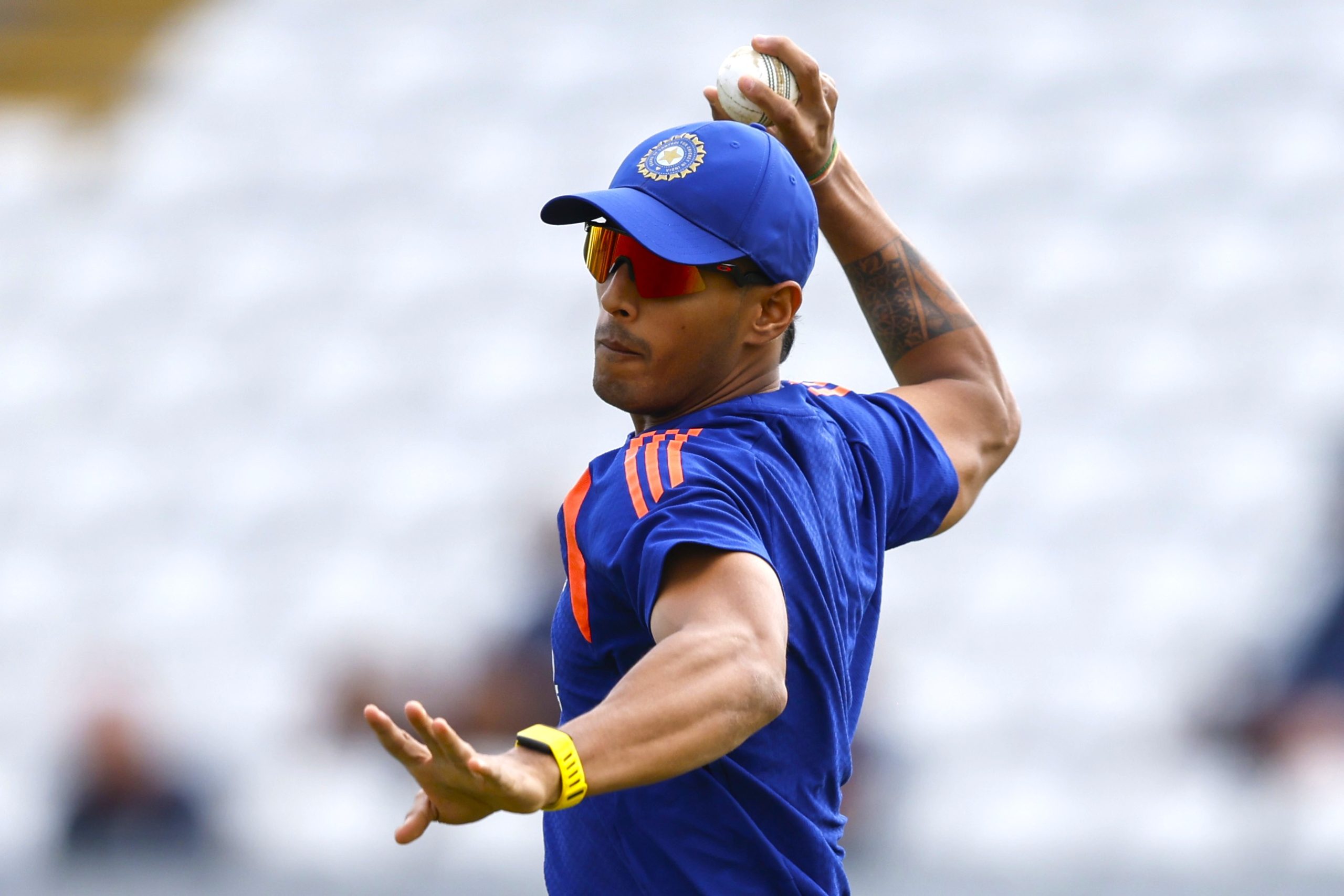
Given the skewed dimensions of the stadiums in England – Durham has a hexagonal shape whereas Nottingham has shorter straight boundaries as compared to Manchester – it is well established by now that fielding will significantly influence the outcome of this series, which India trails 0-1 after two games. Jofra wasted little time in reporting to Sarah Taylor for high catching practice on the match eve before Vaibhav was subjected to an array of projectiles by Tettukandadai Dilip. For the proximity grabs he was stationed at short third man first up, then at slip. Skiers and parallel hits ensued, with Vaibhav also getting a feel of the swirling ball as the coach maneuvered the bat angle.
Throwing accuracy was fine-tuned as he alternated between having a shy at the flexible stumps placed on either side of Dilip, an advocate of using the wooden bat over the padded version, much like his predecessor Ramakrishnan Sridhar. To conclude the session, Vaibhav was asked to turn around and receive a lighter ball hurled up from a tennis racquet. It was easier said than done because the boy wonder could spring into action at the behest of Dilip, an exercise aimed at improving reaction speed. Having gone through the motions duly, a collection tutorial was in store for Vaibhav, who was guilty of clasping at the ball at times in a way similar to the movement of a crocodile snout.
“He’s made that look VERY easy!” 🙌
Shreyas Iyer departs after a smart catch from Tom Banton ❌ pic.twitter.com/VXf0LnS6Dm
— Sky Sports Cricket (@SkyCricket) July 4, 2026
Asked about his assessment of India’s fine display, Sitanshu Kotak emphasized the value of systems. “The management thinks long-term. Post our World Cup win itself the planning for the next marquee event has begun. Every team will go back to the drawing board and focus on the areas in which there is scope for improvement. Our mission is the same. We want to ensure continuous growth in all three departments, be it batting, bowling or fielding.’’
“Yes, it can pose a challenge here and there because we’re transitioning as a team,” Kotak addressed the elephant in the room. After all, India is winless on the trip to United Kingdom, the first time since 2021 when the heavyweights have conceded three completed T20Is in a row. “The leadership has changed. Hardik Pandya is unavailable. Three to four young players have been introduced. So, despite the broader issues and the individual limitations, we always try to push ourselves. If we harbour aspirations of winning the next World Cup, we’ll have to do better than what we have done in the previous edition.”


