

Wellington being the capital of New Zealand is home to the New Zealand parliament, whose executive wing is nicknamed The Beehive for its distinctively circular, tiered shape, which resembles a traditional woven wicker beehive or skep. Bees exhibit several behavioural and social traits including hard work, focus, teamwork, cooperation, and sophisticated communication. Normally all these qualities are displayed in abundance by the Blackcaps but in the ODI series, the Indian bowling unit is the one operating exactly like the bees. What they lack in experience they are making up with discipline and commitment.
The proceedings in Wellington had a feeling of Déjà vu to them. Rain before the start of play, India winning yet another toss, electing to field first once more, both teams announcing unchanged playing XIs, and India rocking the hosts with early wickets. In ODI cricket you want your best batters to bat in the top three spots so that they can bat for the maximum amount of time and set up the game nicely. India’s top three are Rohit Sharma, Shubman Gill and Virat Kohli. Compare their stats to that of New Zealand’s top three and the difference is mind-blowing.
Due to the retirement of Kane Williamson and the injuries to Rachin Ravindra and Devon Conway, New Zealand are having to make do with Tim Seifert, Will Young, and Henry Nicholls. Seifert is approaching a century of T20Is but he’s wet behind the ears in the 50-over format internationally. Despite having earned 64 and 93 ODI caps respectively, both Young and Nicholls have never been able to secure a permanent spot for themselves in the playing XI.
India’s top three not only have 3.82 times the experience compared to their Kiwi counterparts but have also scored a whopping 6.78 times the number of runs scored by New Zealand’s current top three.

New Zealand’s best batter in the format by a distance, Daryl Mitchell, bats at number four, but with such a fragile top order he is unlikely to get a decent platform from where he can come in and execute his natural game of smart and steady accumulation. In the first ODI Mitchell walked in at 40/2 and recently at 11/2. On both occasions the surface was doing a bit, and the Indian bowlers were on top. On both occasions Mitchell had to bide his time and rebuild.
On this tour Glenn Phillips has piled on 371 runs in 7 innings, but he bats too low – at number six – in the ODI team. His entry points in this rubber have been 84/4 and 53/4. However good your form is, it is tough to regularly walk in when an innings is in disarray, resurrect for long periods of time and then try to take the team’s score to some sort of respectability.
Most cricketers prefer having a set batting number but considering New Zealand’s luck with injuries in this series flexibility is the need of the hour. Promoting Mitchell to number three and Phillips to number four looks like a viable solution under these circumstances. Mitchell Santner got valuable runs over the weekend, but the home team would ideally prefer him at number eight where he can strengthen their lower order. Twice in two games now they have failed to bat out the stipulated fifty overs by some distance and the totals they have put up on each occasion have been well below par. A key element in restricting the Blackcaps to middling totals has been India’s out-of-syllabus question called Gurnoor Brar.
Drop an emoji to describe that over! 👇😎
Updates ▶️ https://t.co/pxZRYf6dYV
#TeamIndia | #NZvIND https://t.co/3NtJkjdBdj
— BCCI (@BCCI) November 7, 2026
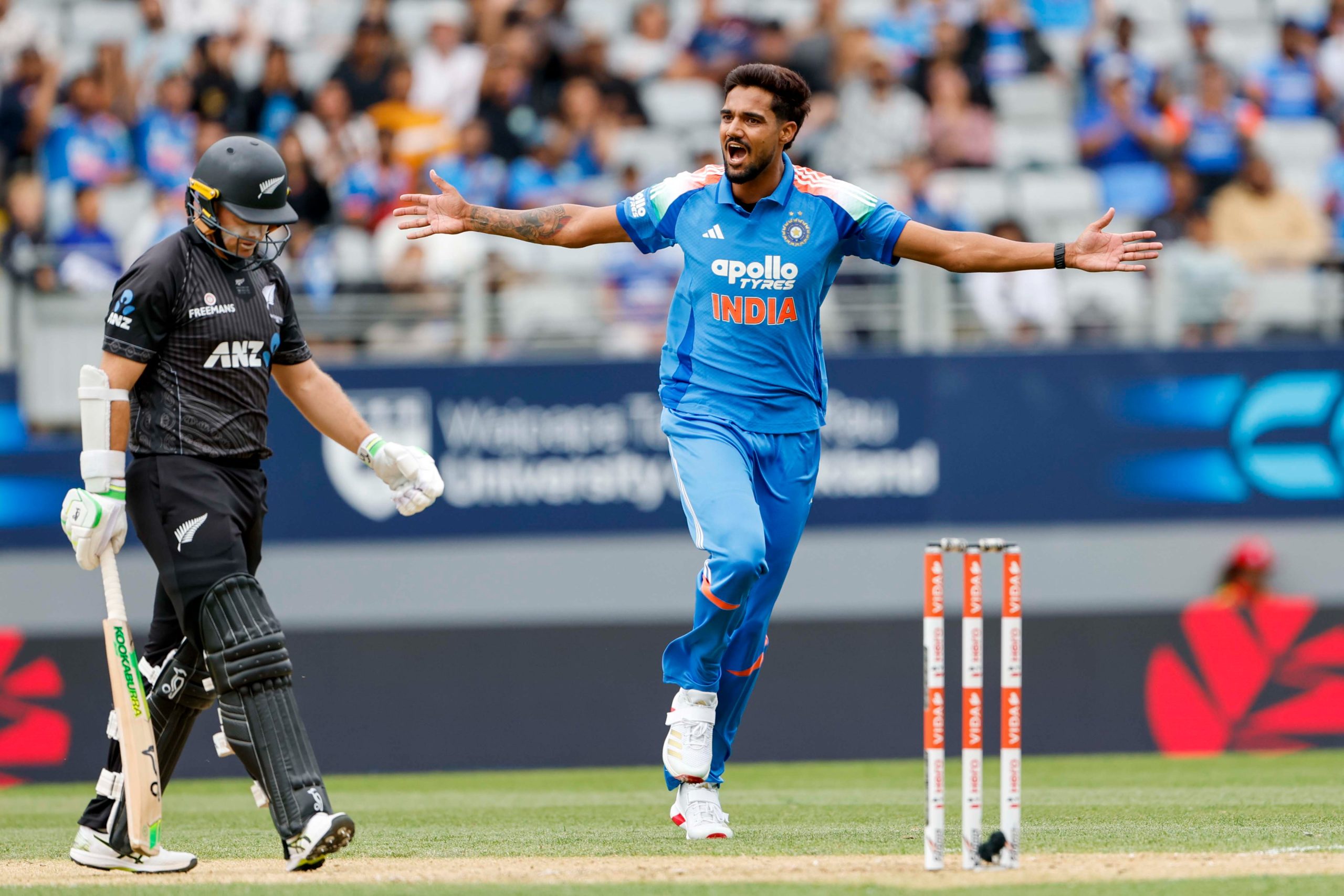
Indian fast bowlers troubling overseas batters is not an alien concept anymore but the way Gurnoor is making life uncomfortable for the natives in this series is a refreshing sight, nonetheless. Brar is special because of his rare combination of towering height, raw pace, and the ability to generate steep bounce from a length. Initially he used his 6 feet 5-inch frame to play basketball and only switched to serious cricket at the age of 17. Impressive domestic and India A performances were followed by a Player of the Tournament showing in 2024 Sher-e-Punjab T20 League. With 3/44 in his Auckland kitty, Gurnoor earned the player of the match award for figures of 4/30 in Wellington.
Four of his seven wickets in this series have come from well-directed bouncers. Brar doesn’t have a very long run-up, with his pace being a by-product of the smoothness of his action and the optimal use of his dominant shoulder. There is still scope to improve the brace of his front leg, and if he can optimise the use of his non-bowling arm then Brar could be rattling the speed gun harder.
“For me, the length I bowl is the key,” Gurnoor outlined his approach. “I know that my short ball is effective but if I overuse it then it won’t have the same surprise factor that it currently has.” He also spoke about the inputs received from Umesh Yadav, his new Punjab teammate.
India’s bowling coach Morne Morkel made a career out of spewing venomous lifters to batters around the world. Gurnoor mentioned how Morkel has helped him to adapt to different pitches and change his length accordingly. He spoke about his discussions with his captain and other senior batters in the team around their pet peeves facing the speed merchants. He is currently like a sponge, absorbing everything from everyone and then adding it to his database to use when the time is right.

On the field Gurnoor is not afraid of being in the batter’s face, telling them what he thinks of their technique and giving them emotionally charged send-offs but as soon as he crosses the boundary line Gurnoor is one of the nicest guys. If he continues along this trajectory Gurnoor will be a handful in the middle overs in South African conditions at the ODI World Cup next year. The prospect of seeing him one day with the red ball in hand is also mouth-watering. An Indian is hurrying batters and bouncing them out. Their batters have been at the receiving end of such treatment for years and it’s about time the Asian powerhouse returned the favours with interest.
India made a straightforward run chase of 135 seem like an obstacle curse. Yes, it wasn’t an easy pitch to bat on but the shot selection of the Indian batters left a lot to be desired. Rohit and Virat came across as too expansive, Shreyas Iyer’s issues with the short ball resurfaced, Axar Patel’s ramp and Naman Dhir’s hook didn’t meet the demand of the situation, and for the thinking cricketer Anshul Kamboj is he ought to reflect on his ugly, ill-fated shot. At 113/7 India still needed 22 runs when rain jeopardized what was turning out to be a nail-biting finish. Much to their relief, India were 4 runs ahead of the DLS par score at that juncture and were eventually declared winners taking a 2-0 lead in the five-match series. The next match is in Hamilton and for a third game in a row the weather is not looking too flash at this stage.
New Zealand general election results were announced on Saturday and as expected it’s been a close shave with the present ruling coalition expected to just scrape through with a one-seat majority. Incidentally, the colour of the biggest party of the ruling coalition is blue as well, rendering it a day of touch-and-go humdingers.


One thought on “No shrinking violet, Gurnoor Brar is adapting on the fly”
The question is should we be moving Mitchell to 3 in these sorts of ODIs… great read here Rahul