
The architect of India and South Africa’s finest hour, Gary Kirsten vows to restore Sri Lankan pride

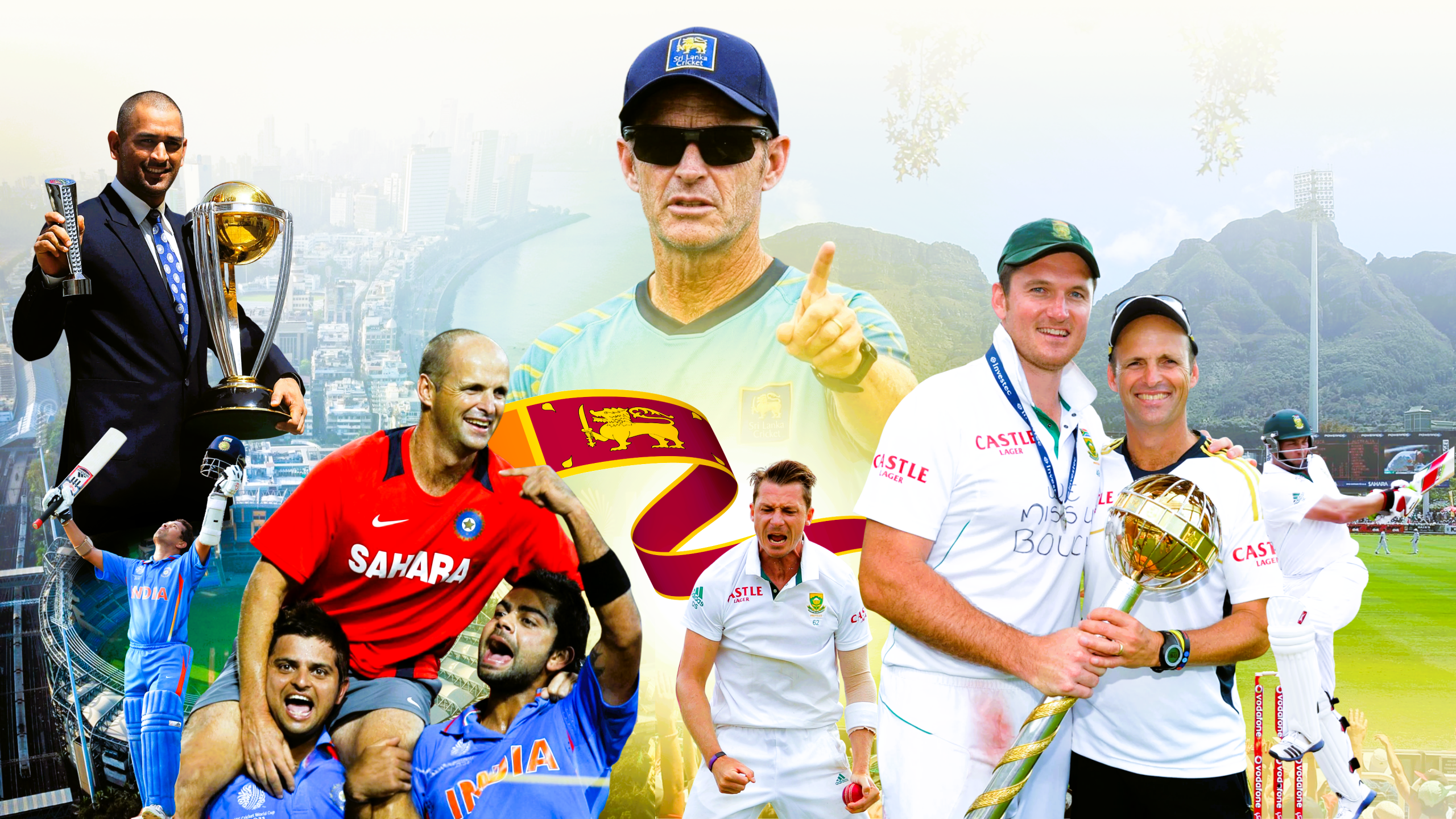
April 2, 2011. If you close your eyes, you can still hear the deafening roar of the Wankhede Stadium. Amidst the energized sea of blue and the fluttering Indian flags, one image stands still: Gary Kirsten hoisted onto the shoulders of the triumphant blue brigade. He isn’t holding the trophy; he rarely needed the spotlight, but his million-dollar smile says everything. In that iconic moment, Kirsten was immortalized as the adored architect of a nation’s dream. To see him in that red training kit, elevated by the players he unified towards a long-cherished goal, was to understand that this quiet South African was the engine behind the victory India yearned for 28 years.
Now, a decade and a half later, Kirsten finds himself in the camp of that fateful day’s other protagonist. Shorn off the wherewithal of legends like Mahela Jayawardhane who scored an unbeaten century in the final, Sri Lanka has turned to the same ‘Guru’ to lead them back to the summit by the 2027 ODI World Cup. The islanders, once a giant on the international scene, have gone adrift in recent times, with a tepid 2026 T20 World Cup campaign serving as the perfect microcosm of their decline.
To establish the premise of Kirsten’s herculean task, one must look at the climate he is entering in. In 2007, notwithstanding a T20 World Cup triumph, India endured a humiliating first-round exit in the ODI counterpart after losses to Bangladesh and Sri Lanka. The atmosphere was heavy with disillusionment, as fans and former players called for an overhaul of the leadership and coaching staff. Kirsten arrived in 2008 amidst this negative environment and ushered the Asian giant towards an unforgettable zenith.
At present, Sri Lanka face a hauntingly similar crisis. Brickbats came their way following a horror show in the T20 marquee event in India earlier this year, which included a takedown by Zimbabwe. As captain Dasun Shanaka noted in the aftermath, the negative chatter outside the dressing room has affected the morale of his boys.

While the scale of expectations in India is incomparable courtesy of their cricket-mad population that is worth a billion, the psychological rot in Sri Lanka is a direct parallel that Kirsten is uniquely qualified to fix given the administration creates a fertile ground for the green shoots to bloom, for that wasn’t the case during his stint with Pakistan. He was six months into a two-year contract and departed on the eve of the white-ball tour of Australia, without having coached Pakistan in a single ODI as their cricketing ecosystem descended into familiar tumult, depriving international coaches of selectorial say even as the selection panel itself resembled a revolving door.
Kirsten’s coaching philosophy is built on the bedrock of man-management. He operates on the principle that if you truly want to win, you must stop thinking about the outcome. During his tenure with India, the locker room was rarely home to conversations about winning the World Cup; the Indians talked about playing their best game to alleviate the nerve-wracking pressure.
“I think the next component to that is every team needs individuals in the team that are willing to step up and make those hard performances when the team needs it. And each team, when you’ve got a good group of those guys, they win games out of nowhere and perform when you really need it,’’ Kirsten elucidates.
He views life and cricket as a marathon, not a weightlifting contest. While the public lays the metaphorical heap of bricks on an athlete’s cranium, Kirsten visualizes a finish line where the players and fans cross together in camaraderie. For a young Sri Lankan squad anchored by Pathum Nissanka and Dunith Wellalage, Kirsten can act as a shield, protecting them from the disapproving eyes that often stifle growth in Colombo.
However, the Kirsten imprint is as much about hard data as it is about heart. The foundation he is being asked to repair has too many tactical loopholes. Since 2024, spinners bowl over 66% of Sri Lanka’s overs at home, leaving pacers with inadequate miles under their legs. Backtracking the point of calculation to 2022, their pacers have had a better average than the opponent in only five of 13 multi-match Test series. Three of them have been against Bangladesh, and one against Ireland. Only once have their speed merchants thrived against an elite side, with that performance against Australia transpiring four years ago.

To succeed in the African countries which will jointly host the World Cup, Kirsten should draw from his intimate knowledge of the conditions and press for sporting pitches in-house to groom a pace attack that can survive outside the subcontinent. Sri Lanka don’t need to look too far for inspiration, for in March the spin-loving Bangladesh played Pakistan on a sprightly deck in Mirpur, facilitating the emergence of express quick Nahid Rana.
“It’s going to be very different conditions to what a lot of the guys are used to, so how do plan for that? It’s about making sure all our bases are covered in the skillsets of the team,” Kirsten said. “Do we have guys with great air speed? Do we have guys that can swing the ball? Do we have guys that can bowl with bounce?’’
Kirsten’s coaching lessons include the art of adaptability, best exemplified by South Africa’s red-ball conquests in England and Australia on either side of August 2012, when the Proteas became the best in Test. He was also central to India’s developments in the whites as they won their maiden Test series in New Zealand and drew an assignment in South Africa for the first time. India’s technique against pace improved, with the batting average against fast bowlers rising from 33.5 to 39.8.
Kirsten’s fingerprints on the willows is precisely what the doctor has ordered for Sri Lanka as their top seven have collectively averaged just 28.05 versus pace in Tests outside of Asia since 2023. With tours lined up in West Indies and New Zealand, territories where seam movement is a factor, the onus is on Kirsten to turn his batters into all-weather customers.
The run squeeze is not confined to the purest version of the game. 2024 onwards, Sri Lanka has the worst strike rate against pace in death overs (121.16) and the second-highest dot-ball percentage (38.92%) among the top ten ODI teams. To bridge this gap, Kirsten may fancy replicating his 2011 strategy of designating a utility player at number seven, akin to his utilization of Suresh Raina. That tournament was staged in the subcontinent so Raina was a viable option, but the forthcoming edition is scheduled in a more pace-friendly region so the search for a speedy all-rounder ought to begin.

In 32 ODIs, Janith Liyanage has rolled his arm over on 19 occasions and three wickets is all he has to show for his efforts. Dasun Shanaka has been Sri Lanka’s bulwark for years but his trundlers will sit up nicely when Sri Lanka land on African shores, a fate Chamika Karunaratne met before previous head coach Sanath Jayasuriya started focusing on spin-bowling all-rounders.
Coincidentally, when Kirsten was getting used to the challenge of guiding a team whose cricketers acquire demigod status and, if burning effigies are something to go by, put down from that pedestal on a whim, success was at the feet of their neighbours.
During Trevor Bayliss’ tenure, Sri Lanka recorded their first ever Test win in the Caribbean and Pakistan to complete series wins against all Test playing nations. Bayliss never lost a home Test series. In fact of the 12 Test rubbers he oversaw, Sri Lanka conceded just two, in Australia in 2007 and India in 2009. Remaining highlights of his tutelage were winning the Asia Cup and reaching the grand finale of the 2009 T20 World Cup as well as the 2011 ODI World Cup. The current reality, much to Sri Lanka’s chagrin, is poles apart from that golden era featuring greats Kumar Sangakkara, Rangana Herath, Tilakaratne Dilshan, Chaminda Vaas and Muttaih Muralitharan.

Despite having played 100 ODIs since the start of 2020 – more than any other Full Member, Sri Lanka have aggregated merely 25 ODI hundreds. In comparison, India have 38, New Zealand have 35, and Australia 32. Fitness woes muddy the waters even further, with Sri Lanka having lost all three of Eshan Malinga, Matheesha Pathirana and Wanindu Hasaranga at different points across the 2026 T20 World Cup.
“Fitness is about keeping people on the field for as long as possible. You don’t want to have injuries where, in an important match, guys are not available,’’ Kirsten stated. ‘’For me, what’s also key is that we have a lot of depth in the group across the different formats. So you are able to rotate players when you need to.’’
Safe to say, there’ll be worry lines on Kirsten’s forehead as an approximate of 20-25 ODIs lie in wait ahead of the global competition. “Every series we play going into the World Cup, we want to give a good account of ourselves. We’ll be aiming at progressing and improving as we get closer,” Kirsten enthused in his preliminary media briefing.
He is going to be a busy man hitherto, confirming plans to head down to Galle immediately to watch Sri Lanka A in action against the Kiwis. Over there he’ll be witnessing from close quarters the up-and-coming talent, which Sri Lanka has never really had a dearth of. All they need is the experience and soft skills Kirsten brings to the table, so that the emblematic lion can rediscover its roar.
*with statistical inputs from Darpan Jain


