

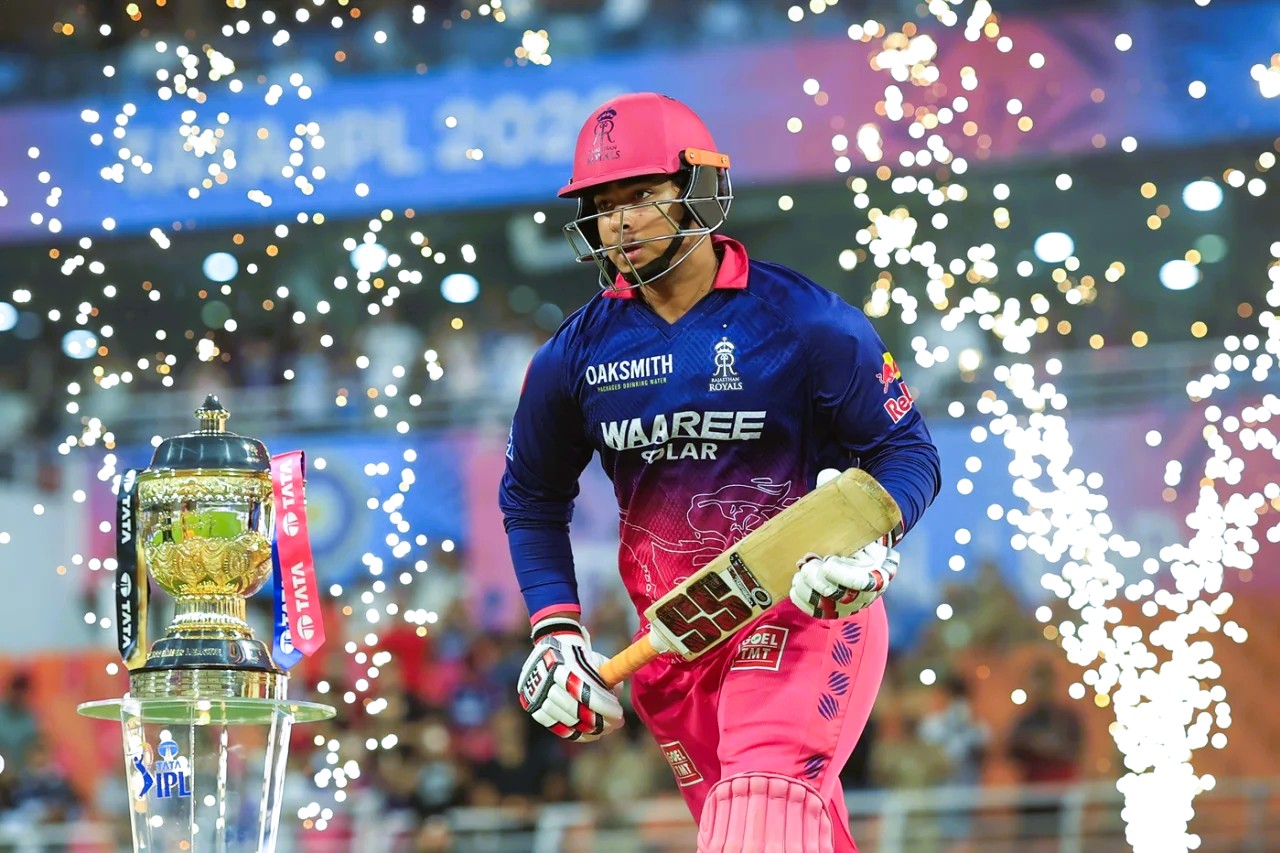
How fitting then, that in the final of a tournament where boundary-hitting was a stroll, one team barely scraped past 150 and another had to dig deep to chase it down? For much of the last month, the IPL was a numbing event, matches of similar shades blurring into each other, one four impossible to tell from the next. Bowlers had been turned into secondary citizens. This one time, a team scored 265 in 20 overs, and their opponents waltzed past it. It was incredibly satisfying, then, to see bowlers dominating the final, even if the final flourish belonged to a batter—who, by the way, thrives on tough batting conditions.
Two quotes, from cricket’s Mount Rushmore candidates, linger in the memory. One came from Muttiah Muralitharan, part of the coaching staff at Sunrisers Hyderabad: “If we give fair wickets, the spectators will say it’s become boring because the T20 followers want entertainment, so they want to see the fours and sixes. That’s why the tournament is built like that. It is a big business at the moment, sponsors and everything, so you will lose the sponsors and interest of the people if you change it.” Murali smiled through it, but there was a resignation in his voice, a helpless bowler stuck in a batter’s carnival.
Another came more recently, a day before the final, from Sachin Tendulkar: “The Impact Player rule needs to go away. I feel in a T20 format, you only have to play twenty overs, when you add one more batter to it, where bowlers are already challenged, I find that imbalanced.”
These are laments, not observations, and they cut against the grain of what the IPL represents.
In the minds of the tournament’s designers, the IPL is a perfect creation, symbolising the BCCI’s power, influence, and gift for spectacle. There is pride in the scale of the audience, the millions who tune in regardless of who’s playing or the shape of the contest. Arun Dhumal, the IPL chairman, has been talking about expanding to ninety-four games and hunting for calendar slots to fit them. If Muralitharan’s words, from inside the machine, are any guide, it would be naive to expect a correction toward balance. Tendulkar’s call, at least, was echoed by several franchise captains who want the impact player rule shelved. Any change, if at all, will have to come from internal resistance.
Hindsight always grants us perfect vision, but it’s fair to suggest that the final was decided within the first twenty minutes, once Josh Hazlewood and Bhuvaneshwar Kumar used climbing short balls to send back Shubman Gill and Sai Sudharsan. Both Hazlewood and Bhuvi, as he’s affectionately called, have defined Royal Challengers Bengaluru’s title charge over the last two seasons. Similarly influential, for Gujarat Titans, were Kagiso Rabada, Mohammed Siraj, and Rashid Khan. In the second innings of the final, Rashid hauled Gujarat Titans back into the game with two wickets in his first over. Rabada and Bhuvi finished as the top-two wicket takers of the season, with Rashid backing them up at number four.
Out of absolutely nowhere! 🌪️
Are we seeing a grand comeback in the grand finale? 😬
Updates ▶️ https://t.co/Yz6K3q6w0X#TATAIPL | #Final | #TheFinalLeap | #RCBvGT | @gujarat_titans | @rashidkhan_19 pic.twitter.com/C3qmvcGs4A
— IndianPremierLeague (@IPL) May 31, 2026
Bhuvi and Virat Kohli, then—memorable, important studies in the persistence of craft and work ethic. They’re roughly the same age, but the discourse around them has been so different.
There’s a clip, now famous, from the RCB auction preparation: Dinesh Karthik tells coach Andy Flower, “I am convinced, Bhuvi is India’s best T20 bowler after Bumrah,” to which Flower responds, “What?!” DK’s was a tall claim, given Bhuvi’s absence from the India setup since 2022. In that time, Siraj, Arshdeep Singh, and Harshit Rana have all made their place within the Indian squad. Not to forget Hardik Pandya, who often bowls a few overs in the powerplay. By season’s end, Bhuvi had people talking about an India recall. Even in the final, reading that Sai was comfortable with fuller deliveries, he went short and picked him off with extra bounce.
Virat Kohli, meanwhile, kept doing what Virat Kohli does—only better. Over the last couple of years, he has willingly remodelled his T20 batting, to suit the power-hitting requirements of this era. That growth, evident in 2025, continued to show this season, most brilliantly in his two battles against Kagiso Rabada at Ahmedabad—one in the group stage; the other in the final, when his three fours and a six practically punctured Gujarat Titans’ defence.
Of his famous training video from Adelaide in 2018, Gideon Haigh had written, “The soundtrack is a succession of improbably deep detonations from Kohli’s bat, echoing off the stand’s bricks like a skeet-shooting rifle.” Improbably deep detonations is perhaps an apt way to describe what we saw in those two exchanges—especially the sequence in the final: the flicked six soaring over mid-wicket and the pull, right after, that sounded like a firecracker going off.
Kohli finished his season with 675 runs at a strike-rate of 165. He scored 23% of RCB’s runs this summer. There’s an argument to be made that this was his best batting season yet. That a 37-year-old batter is still finding ways to improve himself is, by itself, quite remarkable, and telling of his dedication towards his craft.
It was pleasing to see the two other finalists, Gill and Sai, continue to erect monumental aggregates through classical, four-dominant batting. Gill and Sai each scored 700-plus runs at above-150 strike-rates, and topped the season charts for fours—74 and 75, respectively.

For all our obsession with six-hitting, these two were showing that it’s possible to reach the same destination through a completely alternative route. That said, Sai could use some drills on how to keep the bat in his hand. Shubman’s century in the second qualifier, against Rajasthan Royals, was the kind of innings very few can play in T20 cricket, and fewer still attempt.
And yet, for all those players, for every glittering exhibition of skill that this tournament makes space for, IPL 2026 will forever be remembered for the full-scale arrival of Vaibhav Sooryavanshi. For starters, his numbers in raw: nobody, in the nineteen seasons of the tournament, has scored nearly as many as his 776 with a strike rate in his vicinity. But, numbers are only the front gate to the Vaibhav Sooryavanshi Experience.
There was a slight fear at the start: what if the second season blues caught up with him? In the time between his debut last year to the start of this year’s IPL, Sooryavanshi had only grown, not only by age. He piled on the runs at the Under-19 World Cup, and finished with a blistering 175 in the final. He was ready. But, he was still fifteen! How ready can a fifteen year old truly be? We got the answer in bold font, against Bumrah, Hazlewood, Cummins, and Rashid. All of them came back wiser, more equipped of his strengths and aching joints, and all of them were dispatched into the stands. With every game, we got a bit more confident of conferring on him the label of child prodigy, but the thought of his age just kept tugging at us. We were all playing the role of aux-parents, trying to wrap him in cotton wool, and he’d break out every time.
Maybe that thought is a good way to understand just how good he was: by the time he got out for 97 off 29 in the eliminator against Sunrisers Hyderabad, his age had gone from subject of sentences to an exclamation mark. He had shown his mettle for long enough, in varied enough circumstances, against bowling wide enough in range, that it was time to step aside and let him go where he wanted. Any batter, anywhere, would be proud of that blitzkrieg. Three days later, Sooryavanshi followed that up with a 96 that was calculated, measured, but still scored at a strike rate greater than 200. By this time, he was practically carrying all of Rajasthan Royals’ hope on his broad shoulders. Like Himanish Ganjoo detailed, Sooryavanshi’s season, considered for impact, is the greatest batting season in IPL history.

A talent like this cannot neither be imagined nor engineered, but a story like this is perhaps what the Indian Premier League always wished for. And, to its credit, the tournament kept surfacing players from beneath Indian cricket’s gleaming top layer. We’ll be tracking Praful Hinge and Sakib Hussain with keen eyes, along with Urvil Patel, Kartik Sharma, and Mukul Chaudhary. Raghu Sharma spent a career’s worth of time travelling between nets, and finally got his moment in the spotlight. Mohsin Khan showed, once more, why, when fit, he is irresistible.
See, too, the kind of doors IPL can open for its most consistent players: Sooryavanshi has made it to the India A team; Prince Yadav, not long ago a journeyman in state competitions, is in the senior side for the Afghanistan series.
Players like Prince and Urvil get to show their wares in this competition because its design forces teams to divide top-level talent, and make space for potential. One of the IPL’s genuine strengths is the evenness of auction purses. That manifests to ten teams full of match-winners and potential game-changers. Every team is equipped to jostle for the playoffs. We saw a ridiculous momentum swing this season, when Punjab Kings, after six wins in their first seven, fell off a cliff and lost the next six. Spots that we felt were locked midway stayed open until the last couple of games in the league phase. As long as the tournament stays true to that ethos, of every franchise entering with an equal chance of building a good team, they’re guaranteed of good competition.
A quirk of the same design is that many teams, although built with good parts, just don’t jell.
Lucknow Super Giants, after finishing in the playoffs in their first couple of seasons, came apart at the seams this year. Captain Rishabh Pant often hinted at too many voices inside the dressing room—a stacked coaching staff, a Director of Cricket who was moonlighting as an analyst for a major cricket channel, an owner who wanted to be seen as a cricket-man.
Their on-field decisions became a window into their muddled minds. One of those was sending a completely out of form Nicholas Pooran to open in a Super Over, against potentially Sunil Narine, who has been a thorn in his flesh. Another was shuffling the batting order every game, and treating a batter of Aiden Markram’s calibre as a room-filler.
7️⃣0️⃣ games, countless memories, and endless drama… and this is exactly where we stand! 📊#TATAIPL | #KhelBindaas pic.twitter.com/VVlGvs63MN
— IndianPremierLeague (@IPL) May 24, 2026
Mumbai Indians finished ninth, their third bottom-two finish in the last six seasons. At the beginning of the season, scrolling through their roster, the five-time champions looked guaranteed for the playoffs and were possible title-contenders. The friction from 2024, after the sudden captaincy change, had been overcome in 2025. This season, although less visible, the crevices inside the dressing room flared up again. Jasprit Bumrah, perhaps tired from the T20 World Cup, barely got off the ground; Suryakumar Yadav couldn’t buy a run; Rohit flickered and fluttered; and Trent Boult, for once, showed his age. Naman Dhir and, to an extent, Ryan Rickelton were the only bright lights in another forgettable campaign that is destined to trigger large-scale leadership changes and, if the winds are to be believed, trades and exits.
The IPL truly holds the potential to become cricket’s first equivalent of the NBA or the Premier League. It has a dense collection of talent and stories. The fanbases are ripe to create a culture out of. But the best sporting competitions, for all their jagged edges, are designed as sporting competitions meant to uphold the best of the sport. The Premier League is valued in billions because it is a great product, not the other way around.
As of the publication of this essay, the IPL still has some flab to shed. The relentless stream of manufactured content, for one; the overwrought storytelling, perhaps another. Every time you want to break for a breath, there is someone selling you insurance, conducting a mid-over interview, letting loose robot dogs, or handing a camera to a social media parasite. All of it gets louder when franchises are valued at more than a billion each and the chairman is speaking of expanding the tournament.
It’s not a coincidence the tournament has rendered half of cricket’s technicians into props. Many years ago, Rahul Bhattacharya likened watching the IPL to encountering a post-modern narrative that seeks to satirise consumerism. “You think, briefly, that the IPL does not need to go so far down the road that it has,” he said. “They could just as easily shave off a couple of hundred million dollars from their billion dollars-plus television rights sale, and build in clauses to safeguard the viewing experience. But this is to misunderstand the IPL.”
And there lies perhaps the next big leap for the tournament: deciding whether it is indeed a cricket tournament or a showbiz event. That will go a long way in carving its place amongst sport’s most watchable shows, beyond the deafening discourse about dollars.


2 thoughts on “Vignettes from the Indian Premier League”
Awesome piece! It has a nice, rhythmic flow.
Enjoyed reading it . From Dravidian to Aryan ; we have come a long way in Indian cricket. Congratulations to Sarthak Dev and Aryan Surana for this platform and hoping such long form content is back in vogue soon !!