

As a culture buff, visiting Assam was on my bucket list for the longest time. I ticked it off in July 2023, avoiding the tourist hotspots of Meghalaya and Shillong in favour of the lesser-explored Guwahati and its suburbs, the silk-producing Sualkuchi and ancient temple town Hajo. Living my dream, I saw garlanded photo frames of singer Bhupen Hazarika in roadside restaurants, spent an entire day traversing a 38-year-old museum built over 17.5 hectares, and worshipped at the altar of Kamakhya Devi before the sun dawned upon the natural beauty of Northeast.
Guwahati is one of India’s fastest growing cities, but my exploration revealed a noteworthy fact. Rapid urbanization wasn’t leaving historical destruction in its wake. Assamese people continue to celebrate their heroes and the state government actively preserves the legacy of the land. I live in Barwaha, a small town in Madhya Pradesh, which calls Indore its economic engine. Its development happened way earlier and significant progress has been made on the cleanliness front, but the growth has unfortunately come at the expense of the prestigious past.
Gandhi Hall, a multi-purpose civic centre, has been hollowed out. The former residence of the ruling Holkars, Rajwada Palace beseeches a modern upgrade. Monuments like Futi Kothi and Chhatribagh serve no purpose except for pre-wedding shoots. Thankfully, the Lal Bagh’s restoration balanced the scales a bit, otherwise the street food of Sarafa Bazaar had become Indore’s only draw. It was a travesty for an area once known for its Maratha royal grandeur, so Madhya Pradesh Cricket Association’s brand new museum is a fine attempt at salvaging the lost pride.

Facing the Madhavrao Scindia Administrative Block in the Holkar Stadium, the gallery was opened for the public in 2025. It is a one-of-its-kind establishment because save for Rohan Pate’s brainchild – Blades of Glory – in Pune, India has few repositories dedicated to cricket. A venue as iconic as the Wankhede too didn’t have its own until recently while Chinnaswamy and Eden Gardens are others that provide spectators an infotainment zone.
Walking past the Wall of Champions that honors the cricketing achievements of Madhya Pradesh, I admire a life-sized bat featuring the triumphant Ranji Trophy 2022 squad members. As I make my way through the whitewashed pickety fence and arrive at the entrance of the museum, I’m welcomed by the silicon statue of Colonel CK Nayudu, who led India in their maiden Test match against England at Lord’s in 1932 and went on to captain Holkars in their invincible era from 1941 to 1955 where they won four out of ten Ranji finals. Rajiv Risodkar, ex-umpire and MPCA office-bearer, tells me he had an incredible aura. Looking at the work of art in front of me, I nod my head in approval.
Hair slicked back with pomade, gold metal embroidery adorning his black military uniform, a yellow belt hugging his torso, Nayudu sets the tone for a trip down the memory lane. A pair of leather gumboots and an army cap, displayed on the left, are both scuffed, perhaps a reminder that his graduation from the school of hard knocks made him an inspiration for the rank and file. A whimsically curious sideye lands on an advertisement of Bathgate’s Liver Tonic as Rajiv informs me that Nayudu was the first Indian cricketer to feature in a commercial. Thousand aura points, to borrow from the GenZ slang, and more validation to Rajiv’s claim.
In Nayudu’s reign, Holkars registered the still unbroken first-class world record of six centuries in a single innings, against Mysore in 1946. ‘’You’ll be surprised to know that even Denis Compton played a season for the Holkars. He was posted in Mhow by the British army,’’ Rajiv exclaimed. Madhya Pradesh remained a hotbed of cricketing activity long after independence. ‘’Madhavrao Scindia conducted an invitational tournament in Gwalior that was graced by the Indian superstars. Satna and Alirajpur were also cricket-crowd magnets,’’ he notifies.

Rajiv adds that Nayudu was a strict disciplinarian, which explains the longevity of his career. 47 years, to be precise, and if you need a visual proof of his toughness a kit bag weighing 30 kilograms is there for your perusal. ‘’These luggage trunks were transported via ships. Sanjay Jagdale’s family safeguarded it for an eternity,’’ Rajiv informs. Move leftward, gaze at the portrait of Maharaja Yeshwant Rao Holkar II, whose patronage benefitted Nayudu, Syed Mushtaq Ali, Chandu Sarwate and Hiralal Gaekwad. In 1915, he invited Sir Patrick Gedess, the Scottish Polymath to design the city of Indore, but upon the sight of a navy blue skull helmet elderly fans may recollect another man carrying that name, the shutterbug capturing the Marshall-Vengsarkar rivalry of 1983.
Ten days prior to the historic final, an in-form Dilip was down on his haunches, writhing in pain. His fractured jaw required seven stitches and consigned him to a mentorship role for the rest of the tournament.
Much to India’s relief, Kapil Dev filled the gaping hole. In a must-win group match against Zimbabwe, India was on the brink of elimination, reeling at 17/5. MPCA have managed to procure a Slazenger mongoose bat similar to the weapon that flayed the Chevrons. It was the maiden ODI century by an Indian player; the unbeaten effort coming through a willow having a triangular splice. In a different section of the museum, the Haryana Hurricane is captured in his delivery stride frame-by-frame. In the second of the six images, he goes airborne; landing leg tucked into the hip, wrist cocked, and neck bending to the side to allow for shoulder rotation.
This biomechanical flexion transpires next to an exhibit of Gary Sobers cover driving Terry Jenner for a boundary to bring up his double century for Rest of World against Australia at the MCG in 1972. The non-striker is Peter Pollock, the wicket-keeper is Rod Marsh, Ian Chappell is at first slip whereas the umpire is JR Collins. Since we’re in the territory of greats, straighten your backs in respect lest we forget the crown jewel. The swords of Sachin Tendulkar – his 10,000th run in ODI transpired in Indore and he crafted an unprecedented ODI double ton in Gwalior – and Sir Donald Bradman are placed adjacently, with a generous helping of linseed oil rendering the latter almond brown.
The Australian virtuoso relied on William Sykes Limited for his tools, and the manufacturer rarely disappointed given his triple centuries, the 1934 Ashes where he scored a staggering 758 runs, and a legendary partnership worth 451 with Bill Ponsford.

Perpendicularly, you’ll find one of the two whiskey bottles on show. It belongs to South African all-rounder Lance Klusener, the Player of the Tournament in the 1999 ODI World Cup. The second, a collector’s edition from Bells Scotch, has aged over vast swathes of time, specifically packaged to celebrate the 2003 event in the rainbow nation. Prominent items dating to the turn of the century include a plate engraved with a picture of Anil Kumble’s face, jaw held together by bandaging gauze. It quotes a taxi driver from Antigua: ‘’What’s your highest national award, ma’an? The Bharat Ratna, eh? Your Kumble should be given that,’’ he suggests, alluding to the 14 overs he bowled on the trot to fetch five maidens and the prized scalp of Brian Lara.
From that era, MPCA’s assortment houses a photograph of the Indian team posing with the then Prime Minister Atal Bihari Vajpayee ahead of an epoch-making tour of Pakistan after a deadlock of 14 years. ‘’Khel hi nahi, dil bhi jeetiye,’’ he blessed the touring party to win both the game as well as acclaim. It is situated between Sanjay Manjrekar’s wool sweater and the double-breasted blazer Chandrakant Pandit wore on the English assignment of 1986, complete with an indigo tie embossed with the logos of the various stakeholders such as the Marylebone Cricket Club. In a coaching capacity, he delivered a Ranji title for Madhya Pradesh after an exasperating wait of 69 years, a soothing balm for the 1999 near-miss as a talisman.
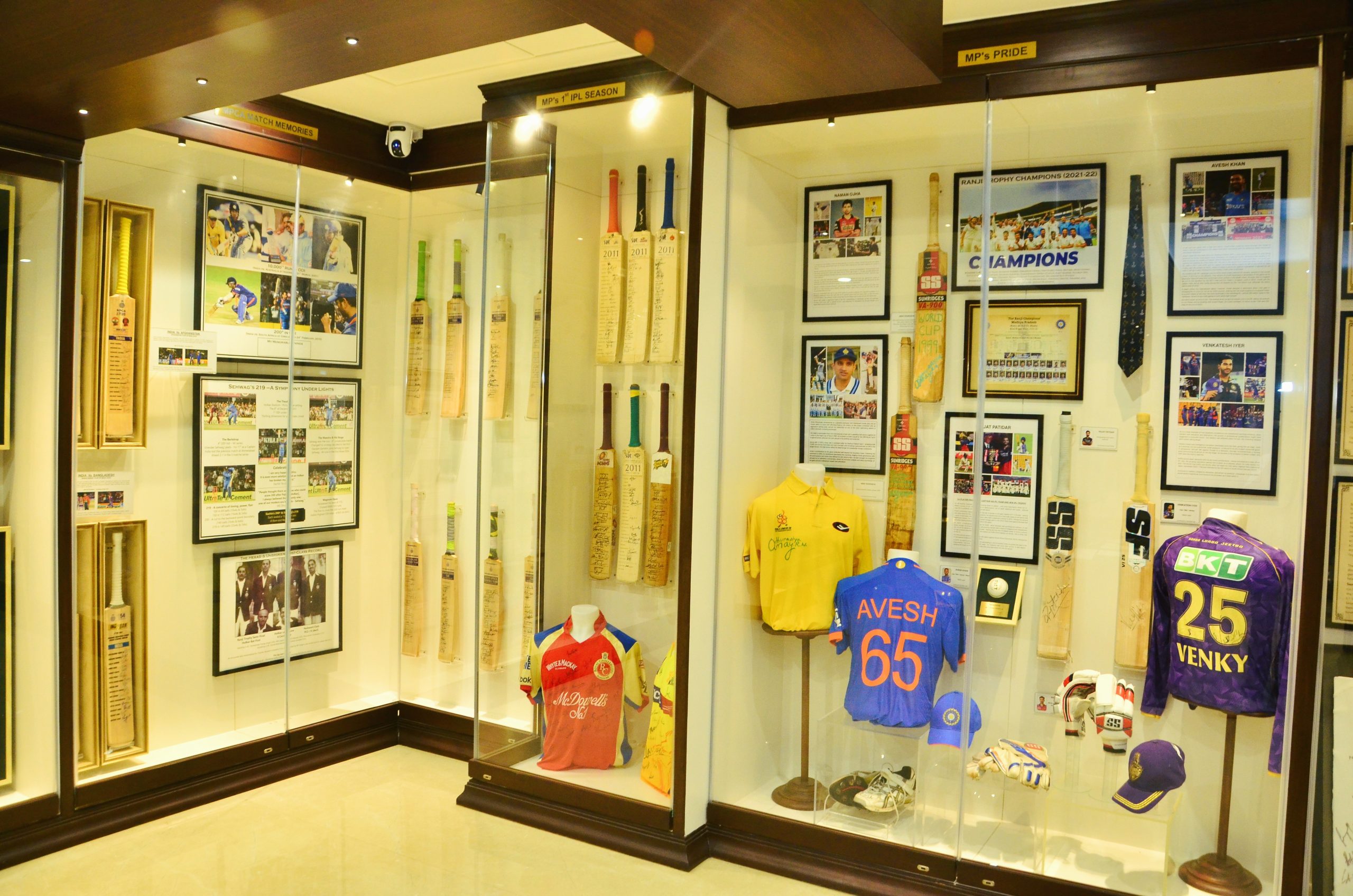
His disciples are also among the chief contributors to the museum’s inventory. Avesh Khan provided his spikes, forgetting to grab a cleaning brush even as the earthy residue gives his grant a realistic feel. Venkatesh Iyer autographed his Kolkata Knight Riders jersey from the breakout 2024 IPL campaign whereas Rajat Patidar bid adieu to the bat with which he tamed Mumbai in the summit clash. Its grains are chipping off, so much so that the underline you draw to cap off a signature was robbed off its freewheeling rhythm. Albeit the condition of his cleft is much better as compared to the memorabilia secured from Suresh Raina – a Sunny Tonny ripped apart in Indore to an extent that separate nuts and bolts were needed to pin the two halves.
Talking of dissection, stumps that bore witness to thrill-a-minute humdingers like the 1986 tied Test between India and Australia in Madras and the 2001 Kolkata epic are cut vertically to be dotted with the mention of the protagonists. Rahul Dravid, a son of the soil considering his birth in a Brahmin family in Indore, has relinquished his ODI shirt. Its loose sleeves are in stark contrast to the compact whites of KL Rahul, embossed with number 284 on the chest. Virat Kohli is too good a batter to not be included in this elite club, even if his inclusion disturbs the namesaking nomenclature. His gloves, the source of a rock-solid grip en route his double ton against New Zealand in Indore, bear pleasantries on the palm. So do those of Madhya Pradesh opener Ajay Rohera, the debutant who took domestic cricket by storm with a record-smashing 267* versus Hyderabad.

It is in the vicinity of many interesting local archives. Vaishnavi Sharma’s hat-trick ball in the latest U19 Women’s World Cup, Naman Ojha and Nuzhat Parveen’s mitts, a polo that Amay Khurasia sported in Malaysia’s Commonwealth Games in 1998, and a token of appreciation extended towards Sudhir Asnani, an ICC panel umpire from the state. The tributes to off-spinning all-rounder Rupanjali Shastri and young pacer Kranti Gaud exist in the august company of the bat of Sandhya Agarwal, the highest run-scorer for India in women’s Test matches.
‘’She made her top score of 190 against England in 1986, beating Betty Snowball’s feat of 189 that had held the record in women’s Test cricket since 1935,’’ Rajiv apprises me. Cotton fabric was what Sandhya rocked in the 1993 Women’s World Cup, for the polyester that lends breathability to Mithali Raj’s jumper on the right was not in vogue yet. A competition of the leading ODI units, the Charminar Challenge Cup is positioned beneath her flannels, glistening in silver. The vintage label can also be assigned to the Ashes toss coin gifted by Nitin Menon, the first Indian on-field umpire to officiate in 150 internationals, and a handwritten note by Aamir Khan ahead of Lagaan’s release. Although his calligraphy is indecipherable, in all fairness, I strain my eyes to make out that he credits director Ashutosh Gowariker for conceptualizing the period sports drama in 1996.
Andy Pycroft, the match referee, has turned back the clock with his Zimbabwean threads. An overall red interspersed by parrot green and ice blue stripes emits the vibe of holiday calm, a trait that laid the foundation of Steve Waugh’s batsmanship. His MRF special edition bat was the churner of 10,927 runs, its stature almost blinding the onlooker to the shenanigans of an aluminum version hiding behind. In late 1979, Dennis Lillee transfigured cricket into a heavy metal concert, quite literally. Striding onto the WACA pitch wielding an experiment dubbed the ‘ComBat’, he left the lawmakers scratching their heads as the cricketing action gained the razzmatazz of a sci-fi flick. The incident led to an immediate change in the rulebook; bats ought to be carved out of wood.
Not everyone requires subterfuge to inflict a leather hunt though. Virender Sehwag bludgeoned 25 fours and 7 sixes to bury West Indies under an avalanche of runs at the Holkar Stadium in the winter of 2011, ending up with 219. You must catch your breath after a throwback to such a sensational knock, hence MPCA has built a brick-themed cafeteria outside. An amble in that direction ushers into your peripheral vision an old pitch roller. Wrought in 1907 and functional till 2025 at the Cricket Club of Indore, it is not just a press in cylindrical form but a proud emblem of the skill and care that went into each mechanical device of the bygone era.

Those virtues are seldom seen in a world of instant gratification, but the Indore Test of 2023 Border-Gavaskar Trophy was an aberration. Standing in for Pat Cummins, Steve Smith and Nathan Lyon devised a 7-2 leg-side field for Cheteshwar Pujara, a wristy nurdler of the ball with fleet-footed movements. The dots piled up, annoying skipper Rohit Sharma in the dressing room, as a message was sent out to counterattack. Eventually the visitors won the first-blink challenge as Lyon and Smith, alert at leg slip, combined to vindicate the trap. Dismissed for 163 in the second innings, India lost at home, an exception prior to the Trans-Tasman hammering. ‘’An Australian jersey, signed by the playing eleven, commemorates the occasion,’’ Rajiv signals.
Like me, if you are an enthusiast for whom the opportunity to spend hours exploring every nook and crevice of the museum and niche-obsessing over the Wisden Almanacks in the library was a ticket to paradise, your legs must be sore by now. The souvenir store, painted in a soothing shade of emerald green, is the ideal pitstop for your brain as well as the body. The stairs leading up to the patio are flanked with knee-length plantations, guiding you to a bevy of elegant resting chairs. Sip on a hydration drink, marvel at the aesthetic lamps, and check the time on the roman clock to pull yourself out of the nostalgic nirvana as a buzz of traffic emanates from the Janjeerwala square.
One final dip into the cricketing ocean awaits before the humdrum of life consumes us mere mortals. Keepsakes run the gamut from keychains, t-shirts, floppy hats, coffee mugs, and a deck of handsketched cards by artist Firos PK, easily the highlight of the shopping avenue. I have to reach home, a bumpy 60km drive from Indore, before midnight so I rush for the exit but there is just enough time for some small talk with the watchman. ‘’Is the footfall decent?’’ I quiz. ‘’Yes bhaiya, a lot of people are swinging by. The museum has become a sightseeing attraction,’’ he answers without missing a beat.
His reply warms the cockles of my heart, for MPCA is furnishing outsiders with the emotionally immersive experience that Indore lacked despite Ahilyabai (1725-1795) undertaking the affairs of the Holkar dynasty with aplomb in a patriarchal society.

In 2025, her 300th birth anniversary was widely celebrated across India, and she was remembered for her contributions to Hindu cultural institutions, including the rebuilding of the Kashi Vishwanath Temple in Varanasi. Her shrine lies on the banks of the Narmada river in Maheshwar, where Prince Richard Shivaji Rao Holkar aims to revive intricate weaves like pajni and ochna to empower women artisans. The airport and university of Indore were christened after her while the plot for this ground was donated to MPCA by the successors of Usharaje Holkar as the 1997 suspension and infrastructural shortcomings led to the demise of the Nehru Stadium.
‘’The kingdom’s support has been instrumental to our cricketing trajectory, and the creation of this museum is an act of gratitude towards their kindness,’’ Rajiv avers.
It is only fitting that the museum commenced operations last year, at a momentous juncture in the Holkar annals, and offers concessional rates for students; an emphatic ode to the social sustainability principle. While we build resources for the next generation, there needs to be an equal emphasis on staying connected to our roots.


18 thoughts on “A postcard from Holkar”
Such an amazingly written piece; storytelling at its best 👍
Thanks a ton!
A piece so beautiful that it should draw more footfalls to the museum.
I’m glad you enjoyed reading my work!
Great piece Aryan!!
Thanks, Ranjeet. Appreciate the kind words!
Felt like read a piece of Indian History, Amazingly Written.
I’m glad the feature resonated with you, Piyush.
It was amazing
Thanks, Vinayak.
Beautifully written. The way this captures the legacy, culture, of the Holkar era feels deeply personal. It honestly makes you pause and appreciate the stories behind our heritage.
Appreciate the positive feedback. I’m glad the feature struck an emotional chord with you!
इंदौर शहर में क्रिकेट के म्यूजियम में बहुत कुछ उपलब्ध है आप के आलेख ने इंदौर शहर की इस जगह को भी बड़ी खूबसूरती से रेखांकित किया है । बहुत ही विविधता भरे इस आलेख से क्रिकेट के प्रशंसक निश्चित रूप से इसे देखने के लिए उत्सुक रहेंगे ।
Shukriya!
बहुत ही शानदार आलेख है,आपका गहराई में जाकर इस तरह की जानकारी निकाल कर लाना काफी सुखद लगा..
इसी तरह की ओर जानकारी के इंतजार में…………
Dhanyawaad.
Wonderful description of Cricket archives at MPCA Museum, your narration about Cricketers and their personal items is very good .
Thank you Sanjeev Sir, appreciate the encouraging words!