

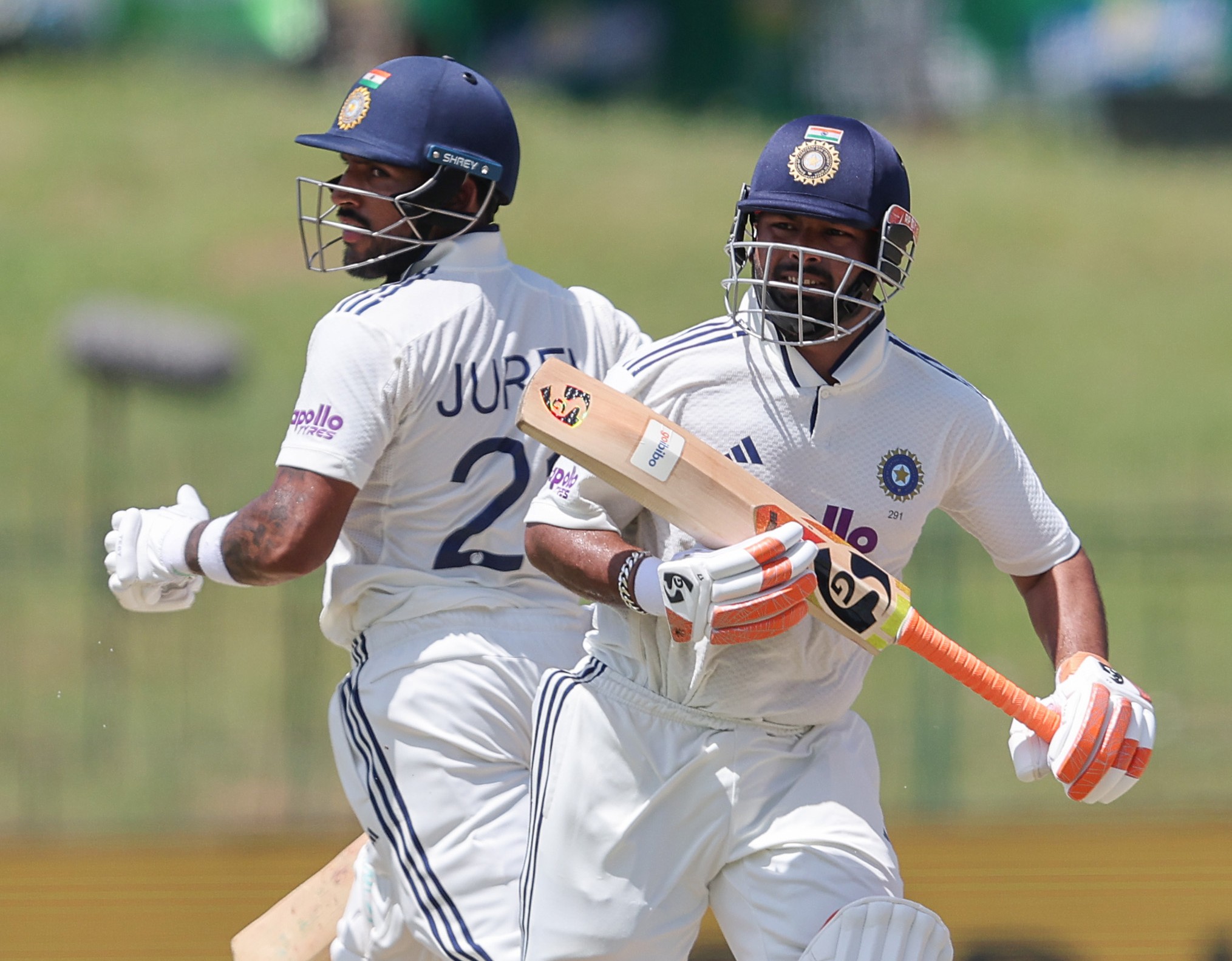
India’s first century stand in Colombo perplexed the living daylights out of Sri Lankan spinners. Devdutt Padikkal met the lengths between three and five metres largely on the backfoot while Shubman Gill was a frontfoot customer, playing 88.13% of the deliveries in this zone with a shimmy or a stride forward. Gauging the pattern, Prabath Jayasuriya and Keshara Nuwantha tried moving up and down the strip accordingly to the left-right combination but India’s scoreline of 186/2 suggested a poor success ratio. Another tactical puzzle awaited the hosts in the making of India’s second hundred partnership as antipodes Dhruv Jurel and Rishabh Pant brought a fusion of flavours to a consolidation gig.
The juxtaposition was evident right from the word go. Jurel hit a couple of aesthetically pleasing drives, knocking the stumps down at the non-striker’s end once and finding extra cover with the subsequent missile. Firmness of thought, to score when the opportunity presents itself, nestled in conventional wisdom that the first half an hour of the morning session usually belongs to the pacers. Pant tore apart that rulebook at the opposite end with a hook shot that landed on the roof of the stadium, denting a solar panel in the process. It was an identical bumper to the one that forced him to retire hurt the day before, yet the southpaw had no qualms taking the aerial route. The distance the ball travelled can be attributed to Lahiru Kumara’s velocity, however the swing of his blade injected an oomph into the shot that spoke volumes of the commitment behind his power game.
The chin music didn’t stop there, though. Rarely does the ego of a fast bowler take a riposte well. Pant copped a number of blows on his right shoulder, an area of attack for Sri Lanka given the archetypal carry in the Sinhalese Sports Club pitch that caught Saransh Jain unawares.
He may have not been able to make an impact with the bat in hand, but the dusty turn and bounce Keshara elicited straightaway upon his introduction would have surely left the debutant licking his lips. Pant, fortunate to have survived a ballooning ricochet that almost kissed the bails off Asitha Fernando, unfurled the paddle sweep twice to fetch consecutive fours. The brooming adventures had Pant spread on the floor at times, even as the controlled pull from Jurel that accrued fifty for the alliance represented symmetry to contrast his partner’s lack thereof.

Attention to detail, a theme persistent in Jurel’s knock till India’s declaration on a weighty score of 503/9, came to the fore in the way the specialist batter picked his spot to dispatch a full toss. By restricting the twirl of his wrists he ensured the gap between deep mid-wicket and long-on was bisected to perfection. Such immaculate dexterity and ownership over the craft is borne out of sincere effort in the nets, and Jurel is no exception. “He has worked really hard on his technique and it’s something unique nowadays,” batting coach Vikram Rathour told Cricbuzz.
“You don’t get too many players with a technique that solid. Because the focus is on playing more shots. Or scoring runs in different areas. When you see him bat in the nets, you sometimes wonder how will this kid get out. There are no visible weaknesses at all.”
In a union of two radically different approaches, there did arrive a convergence point. Pant and Jurel swivelled back to thrash a rank loosener to backward square leg. The former’s average interception was 40cms ahead of the other Indian batters versus spin, a weapon of choice for Sri Lanka that now stood neutralized. In 80 overs between them, the spin twins managed only four wickets at the cost of 286 runs. It is certainly a notch of improvement for an Indian side that was steamrolled at home by South Africa and New Zealand, with the chicanery of Ajaz Patel, Mitchell Santner and Simon Harmer rendering a powerhouse fallible.

Post Lunch, it was Jurel’s turn to live a charmed life. Leg slip dropped a tough chance before a reverse swinging yorker nearly rammed into his boot. When the speed merchant went searching for that lethal inducker again, overcooking the line allowed Jurel a pass to show his strength off the pads. The timing was ethereal, so good in fact that the boundary rider was beaten for all money. With ponderous, greyish clouds gathering over the capital, voices in the cricketing intelligentsia felt India were dragging their heels, noting Jurel’s 13-ball stay on 99. His patience also wore thin at that juncture as Mohammed Siraj responded to an adventurous call. Mid-off swooped in, the healthy bounce aiding his collection, but missed the stumps by a whisker despite having an excellent view. His torso grimey from the herculean dive, Jurel flexed his tattooed bicep in celebration, an elusive moment of refrain from the stoicism that has defined his young international career.
Sanjay Manjrekar credited Jurel for proving his mettle at the big stage after an impressive grind in first-class cricket, highlighting his character via the runs lower down the order against England in Ranchi, often shepherding the tail. The pundit stuck his neck out to argue that Jurel should walk in ahead of Jadeja, a nugget of analysis which might rankle the “bits-and-pieces cricketer”. Shifting his attention to Pant, Manjrekar referred to the batting crease as his territory, a playschool that a kid enters to have fun. Deriving enjoyment from his whacky methods and somehow sustaining them against world-class adversaries, the man who defeated death is now India’s leading run-scorer in the World Test Championship. India are jostling to push from their mid-table status, so contributions from the bottom of the recognized batting order gain importance in the aftermath of all-rounder Ravichandran Ashwin’s retirement.
Two wickets down heading into the moving day, Sri Lanka notice the writing on the wall. If Devdutt Padikkal’s advocacy for the number three position was filed at their expense, the hypnotizing roulette in the form of Jurel and Pant put the game beyond their reach.


