

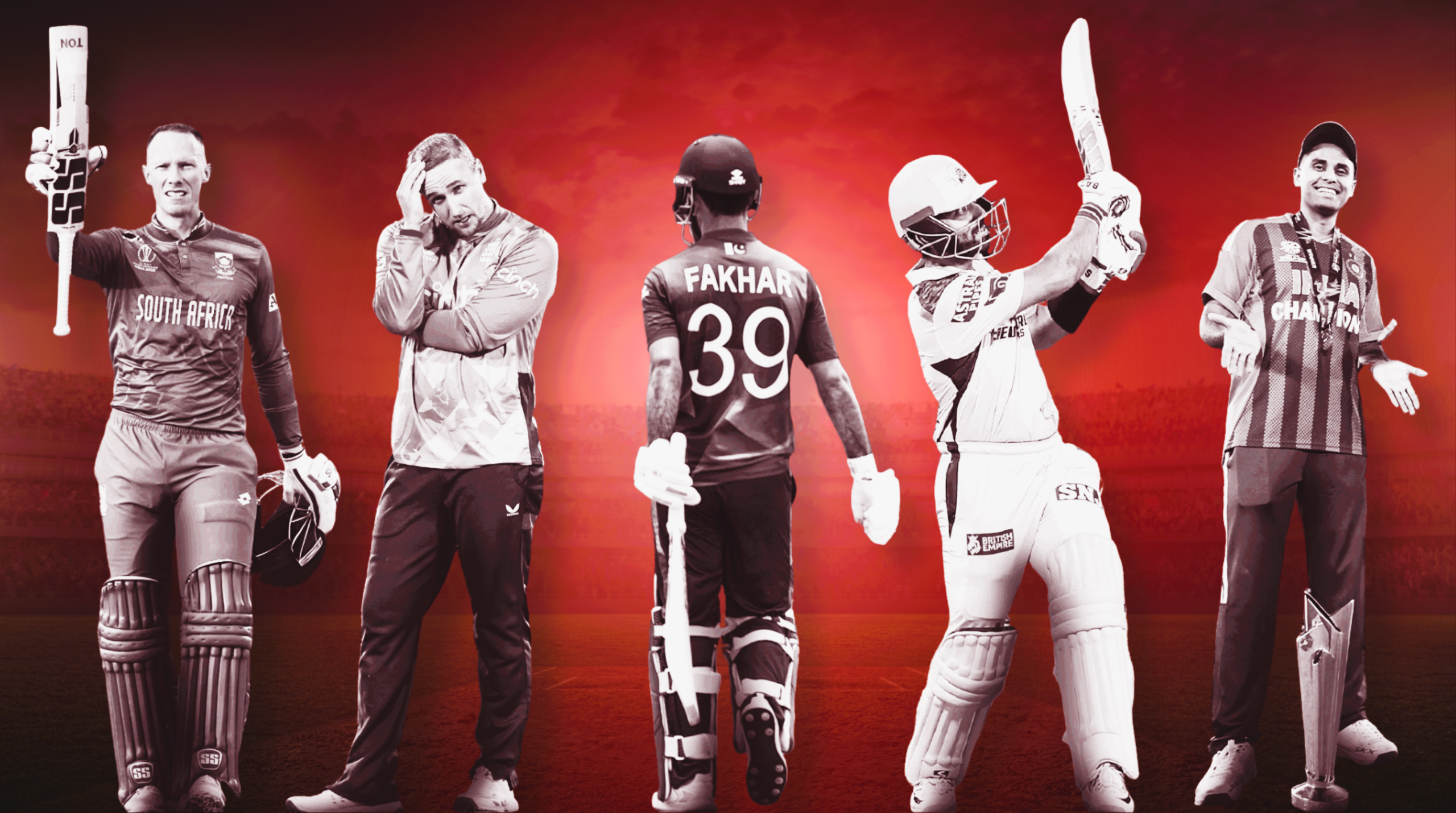
Analyst Ric Finlay conducted a homogeneous study in 2013 to determine the optimum age for a cricketer. His sample was Sheffield Shield data from 1977 onwards, comprising 950 fixtures involving 800 players. He deduced from the results that experience trumped youth, with both batting and bowling averages improving in proportion with age. 32 to 33 being the vintage years, according to his research, was an antidote to the popular practice of considering athletes deadwood once they land on the wrong side of thirties.
The findings were paradoxical in nature because as per science, declining neural speed and muscle fiber loss slows a sportsperson down with regards to reflexes and reaction time, pillars on which the art of batsmanship rests. After a forgettable trip to New Zealand in 2020, Virat Kohli was advised by the legendary Kapil Dev to work harder on maintaining his hand-eye coordination. “When your eyesight weakens you have to focus on your technique. The same ball which he used to pounce on so quickly, he’s getting late on it now. Sehwag, Dravid, Viv Richards – all faced similar difficulties in their career. So Kohli needs to train more.”
That piece of advice would be right up Fakhar Zaman’s alley too. Before hitting the proverbial athletic wall, he scored an iconic 114 to humble India in the 2017 ICC Champions Trophy final. His next blockbuster also transpired in the United Kingdom, then the highest individual total for a Pakistan batter in ODIs versus England. As normalcy touched humankind after an ugly skirmish with the coronavirus, Fakhar’s 193 opposite South Africa in Johannesburg reflected that feeling of liberation at last as Tabraiz Shamsi conceded five maximums in a matter of six deliveries. The leaderboard was quick on the uptake once he carved three successive ODI hundreds against New Zealand, with the dasher next best only to Babar Azam in the 50-over rankings. The world was at Fakhar’s feet, his progression aligning with Finlay’s estimation of a cricketer’s peak.
However, climbing the mountain and staying on top are two different things. Abhinav Bindra experienced a sense of emptiness after clinching the gold medal in the 10-meter air rifle event at the 2008 Beijing Olympics. Having dedicated 16 years to a singular goal, its accomplishment left him profoundly aimless. Turning to Vipassana to overcome the mental fatigue caused by an obsessive sport and rediscover his love for the gun, the shooter went on to represent India at the London 2012 and Rio 2016 editions but ‘laser’ no longer prefixed his focus. “I could have taken the easy way out, that is, if I had retired after Beijing. I was on a high but I decided to continue,” Bindra said, graceful in defeat.
In the cricketing context, Ross Taylor suffered the same fate. He hit the winning boundary as New Zealand lifted the World Test Championship mace in 2021 by crushing table-toppers India, an achievement he deemed a soothing balm for the 2019 World Cup heartbreak. Retirement was around the corner but as a seasoned pro he toured the subcontinent, coming up woefully short on the turners to bow out on a bittersweet note. Some of his dismissals, particularly the hare-brained slog off Ravichandran Ashwin in Mumbai, made the Kiwi fans wonder if he was better off bidding adieu when it was all sunshine and rainbows a quarter ago.
Do Pakistan loyalists entertain similar thoughts given Fakhar, 35 years old with 215 internationals to his name, copped a two-match ban for ball tampering in their own league, which is already mired in controversy? The board authorities certainly did while issuing him a show-cause notice after he publicly criticized the decision to drop Babar from the Test team. An inspection of his recent trajectory opens up a can of worms. Does a bout of illness justify the eight-month long international hiatus after the T20 World Cup in June 2024? Didn’t the lack of strength-and-conditioning effort bother the management when he strained an oblique chasing a ball in the very first over of the Champions Trophy 2025? Notwithstanding Saim Ayub’s exploits in the clean sweep of Proteas, how on earth did Fakhar go from dominating the global chart to losing his central contract within a span of 18 months? Was the system failing him or had he lost the drive to keep up with the professionalism that elite sport demands?
Fakhar Zaman gone, great stumping by Azam Khan 👏 pic.twitter.com/eVW1Rd6ued
— 𝑨𝒎𝒊𝒓 (@Khanu_3) March 29, 2026
The truth lies somewhere in between. Once a cricketer starts approaching the evening of his career, he needs a shoulder of support, which can present itself in various forms. Rassie van der Dussen was a late bloomer yet South Africa were able to extract from his willow seven years of consistency, including two centuries in the foreign, pressure-cooker environs of the 2023 World Cup. A tight-knit dressing room culture that fosetered security and peace of mind was the bedrock of his sustainability. Suryakumar Yadav also made a belated bow by Indian standards, but the sheer backing his talent has received from the leadership is worth acknowledging, so much so that twice he jumped the queue to don whites ahead of the domestic performers. He captained India to glory in the 2026 ICC T20 World Cup, passing on the favour of faith quite inspiredly to Sanju Samson towards the business end of the tournament.
‘’Samson’s international debut was in 2015 and it is after ten years that the world is talking about him. He has a ten-year journey in international cricket and there must have been another ten years before it at the age-group and domestic level,’’ Pakistan batting coach Hanif Malik explains.
‘’Our players do not go through a proper journey. We don’t care for their growth because we have talented players coming through each year, and we jump from one player to another without giving them time to develop. There is no proper preparation for players in our system. We are mostly hopping from one event to another. We need to commit ourselves to a process.’’
The more you sweat in training, the less you bleed in the battle. Ajinkya Rahane’s childhood coach Pravin Amre was instrumental in making his disciple the toast of the comeback club in IPL 2023. Asked to use lesser padding to free up his elbow, the anchor turned into an enforcer without moving away from the elegance that defined his strokeplay. He picked up length in a flash and peppered the mid-wicket region with jabs underpinned by razor-sharp bat speed. Around two weeks into his maiden stint with Chennai Super Kings, Rahane had garnered 125 runs against the seamers, with 80 of them pinched from just 28 balls through the leg side at an astounding strike rate of 285.7. If timely guidance can help him metamorphosize his graph, from an India exit to Kolkata Knight Riders’ helm, Liam Livingstone could also have benefited from clear conversations with the powers that be in English cricket.

Having featured in five consecutive ICC events from 2021-25, including England’s successful T20 World Cup campaign in 2022, he followed the latest from his couch. The all-rounder was dropped from the white-ball set-up last May after bungling up the India T20Is and Champions Trophy, which he described as “the worst experience’’ of his cricketing journey due to the superficial training atmosphere. ‘’You’d hit a couple out of the middle of the bat and they’d go, ‘Great, you found it. Let’s go back to the hotel,’’ Livingstone revealed.
Vibes over volume? Knee-jerk reactions over healthy discussions and mutual agreement? Emphasis on rest and recovery when a serious-minded cricketer aspires to learn and grow? This crime scene had the fingerprints of England head coach Brendon McCullum all over it. Later, during the trainwreck of an Ashes, he suggested chilling on the beach to blow off steam as ‘’overpreparation’’ had resulted in the consecutive eight-wicket drubbings.
Eager to know the path towards resurgence, Livingstone inquired about the communication void over the summer only to be told by England managing director Rob Key that he had bigger fish to fry than speaking to him. “That was a bit of an eye-opening experience about the group,’’ he expressed. ‘’If you’re in, you’re in, and if you’re not in, no one cares about you.’’
‘’I was asking for help and pretty much all I got was that I care too much. When things don’t go right, of course you’re going to care; if I didn’t care, then I probably wouldn’t want to play the sport.’’
Opinions may be divided on Livingstone’s complaints, with many smelling the disgruntlement of unfulfilled potential. Albeit the fact remains that a centrally contracted cricketer, who marshalled the troops in West Indies in late 2024 and scored 719 runs at an average of 38 and a strike rate of 160 since IPL 2025, is well within his rights to seek counsel from the think-tank. The absence thereof means the holder of 100 international caps across formats has internalized the belief that he is unlikely to bat for his nation under the current regime despite viewing himself as ‘’one of the best players in white-ball cricket in England.’’
Livingstone drew comparisons to his interactions with Royal Challengers Bangalore executive Mo Bobat and former England captain Eoin Morgan to highlight the gulf in transparency and diligence. “It showed me that there’s two people doing it the right way. It doesn’t seem the same at the moment.”

Alas, change is the only constant. Prior to the advent of Sahibzada Farhan, Fakhar was Pakistan’s tone-setter upfront. Imam-ul-Haq played second fiddle whereas Babar was the binding glue around whom everyone batted. That axis provided as stable an ODI top three as Pakistan had witnessed in a long while, but order is the exception than the norm in their cricketing history. The southpaws have flunked fitness tests and indulged in self-destructive behaviours right under the nose of an administration living on a staple diet of discord.
The twofold negligence has led to a rigmarole of constant reshuffling, inconsistent performances, and a dearth of clarity for personnel. Eventually, having ran the gamut from Mohammad Rizwan to young Ayub to Abdullah Shafique, Pakistan are yet to designate an ideal foil to Farhan. When push came to shove in the T20 World Cup 2026 because of their poor planning, the squad members were fined 5 million in local currency each, a blame-shifting move widely criticized as counterproductive to team morale.
‘’Talent helps in the identification of a player, but what helps them succeed is character-building,’’ Hanif remarks. ‘’That requires a proper structure and process in which you map how a player will evolve as a professional.’’
‘’Our cricketers are not behind their counterparts around the world in any aspect but preparation. They are not mentally strong and do not train with consistency. The execution of a player’s preparation here happens only at the international level, where he is already under pressure to perform, which makes him go into his shell.’’
There have been flashes of brilliance that remind Pakistan of how they’ve goofed up by not adhering to the universally-adopted protocols of workload management, upskilling, role definition, and internal bonding. Fakhar and Farhan, promoted up the order, added 176 against Sri Lanka in a Super 8 clash of the 2026 T20 World Cup. To put things into perspective, across the first five innings, their opening pairs had managed an aggregate of 135. In the 25 deliveries post Fakhar’s dismissal, Pakistan laboured to 36 runs at the cost of seven wickets. “Batting was a concern throughout the tournament,’’ skipper Salman Ali Agha admitted.
Not only was it the highest partnership for any wicket in T20 World Cups, the situational impact of the stand was huge. Pakistan faced an uphill task of posting a hefty total to ensure a victory margin of 64, thereby remaining in contention for a semi-final berth. They ended up with 212, thanks to Fakhar’s contribution of 84 off 42 balls. A serial six-hitter himself, Farhan lavished praise on his partner. “The way Fakhar was playing, I actually felt that if he had scored a hundred it would have been even better for the team. But it was my destiny.”
An innings that echoed the belligerence of his heyday ought to have been a wake-up call for Fakhar as well as the establishment, that genius is liable to corrosion if those responsible for its preservation are found wanting in their will.


