

Life, as we feel it, is a pendular movement between resisting and accepting change. As the Indian women’s team begin their campaign of supplementing an ODI World Cup triumph with a T20 title, the men’s team are undergoing a prolonged period of change. From change in management, then leadership, to a large-scale change in personnel. It was illustrated best, perhaps, when, on the first morning of India’s first Test in six months, the BCCI announced two refreshed white-ball squads: one for the UK, and one for the Asian Games. These teams were packed with newness, the newest name amongst them a prodigy who’s pushing the boundaries of power-hitting.
And regeneration was also the spirit through which this Test match was viewed. Between the World Test Championship final of 2023 to the autumn of 2025, the Indian Test team had lost 484 Test matches worth of experience in Ajinkya Rahane, Cheteshwar Pujara, Ravichandran Ashwin, Rohit Sharma, and Virat Kohli. So when the squad for this Test was announced, after a strenuous period of white-ball cricket, the magnifying glasses came out to see the direction in which India were moving. The first name on our lips, Auqib Nabi, was missing from the team sheet.
Nabi had been the spine of Jammu & Kashmir’s triumphant Ranji Trophy team this season, picking 60 wickets at a scarcely-believable average of 12.65. He was the competition’s second-highest wicket taker the previous season too; his aggregate, over two seasons, comes out to 104 wickets at just over 13. In this year’s final, he picked a five-wicket haul, sending back KL Rahul, Karun Nair, and Mayank Agarwal. In the semi-final against Bengal, he had picked nine wickets. And, unlike all other fast bowlers within the Test team’s orbit, Nabi is a proper lower-order batter.
For Ajit Agarkar and co. to overlook him, especially in the absence of Bumrah, defied all logic. What message were they sending to domestic cricket, we asked, if they cannot reward such an incredible, consistent run of form? But, by the same token, they had picked Manav Suthar and Harsh Dubey, entirely on their domestic cricket returns, so maybe they were looking, just differently than how we were.

Both Suthar and Dubey being left-arm spinners and handy lower-order bats, it was always going to be one pick between the both, with Washington Sundar and Kuldeep Yadav as the other spinners in the starting lineup. Suthar got the nod.
Newness, also, was necessary in how India played their Test cricket. In the same time that they had lost all those players, their home record had nosedived. New Zealand and South Africa came over and dismantled India for five out of five Tests. A WTC final spot was given away, in the process. The only proper success came in the spring of 2024, when India defeated a strong England team 4-1 at home. It was hard to tell, looking at the vast swathes of pale orange seats in the bowl of the Maharaja Yadavindra Singh International Stadium—India’s 31st Test venue—but this test, against an opponent who barely play Test cricket, was important.
The first morning gave us a hint at the seriousness of India’s approach. One week after the conclusion of the IPL, where hitting a boundary every other ball was the order of play, Yashasvi Jaiswal and KL Rahul slipped into their whites with minimum fuss. They left balls at will, met the ball under the eye, and drove with restrained follow-throughs. For much of the first hour, they batted at an easy gear, as Azmatullah Omarzai, Zia ur Rahman, and Mohammad Saleem bustled in with spirit. It was pleasing as it was thrilling, for once feeling the rhythmic sounds of conventional cricket while seeing the application of two batters who’d be forgiven for playing a few shots against bowlers inexperienced with the red ball.
It wasn’t easy going. The pitch had no real carry, no pace which the batters could use. Then, there was the oppressive north Indian summer: the temperature climbing to north of 40 degrees with minimal humidity. During one drinks break, KL Rahul laid down under a canopy of wet towels for a quick rest. And while Rahul’s century was laboured, deserving in credit for perseverance, Shubman Gill’s century felt inevitable from the first ball he faced.

His balance was, as always, picturesque, the sound of the ball off his bat pristine. When he drove on the off side, the ball flew past the covers, kissing the lush grass all the way through to the boundary ropes. When the bowlers went closer to his body, Gill drove the ball straight past them, the wine-red MRF logo on his bat upright, parallel to his torso. He played his pull shots with the bat face down, and flicked with noticeable but minimal movement of his wrists. All the exaggerated movements, that a boundary-dominant batter like him had to inculcate for T20 demands, were replaced by classical, economic shapes. Just his languid touch remained, and he wouldn’t be Shubman Gill if that ever went away.
Last year, when Gill was made Test captain, even after a forgettable tour to Australia and a career Test average in the mid-thirties, there was an initial apprehension about his ability to lead while taking giant, necessary leaps as a batter. Six Test centuries and more than a thousand runs later, he’s definitely ticked one box in bold ink. The runs are the public illustration of Gill’s evolution into a premier Test batter, but the reports of his relentless background work, first before the tour to England last year, then after being dropped from the T20 team, speak of a rare drive and dedication. India have the right guy for their next iteration.
Around him, Rishabh Pant, finally in original rhythm after the impostor we had seen in the LSG red-and-blue, strolled to an 80, and Washington Sundar got himself an unfussed half-century. Manav Suthar joined the party with some crisp blows. By midway through the second day, the Afghanistan bowlers were clearly tiring. They had been hurling leather for a day and a half under a weather best suited for balconies and iced beverages. Even so, Mohammad Saleem was a muscular, probing presence, often touching speeds in excess of 140 kmph. His six wickets were well-earned. Just 23, he could well be an all-format fast-bowling spearhead for Afghanistan over the next decade.
At 564-8, Gill finally showed mercy, and called his team in. There was little doubt that India wouldn’t have to bat again. From there on, the Test belonged to Manav Suthar. And to appreciate Suthar’s appearance, it’s important to understand what India have been spoilt with for the last fifteen and more years.

Since Ravichandran Ashwin and Ravindra Jadeja’s Test debuts, within a year of each other, India have been able to field two world-class spinners and top-level all-rounders at all times. This, in turn, allowed India to often play five bowlers. Away from home, India often played three, sometimes four, fast bowlers. Barring Bhuvaneshwar Kumar, most of them didn’t offer much with the bat, but could be accommodated because Ashwin and/or Jadeja would lend balance to the team. And, in recent years, if either got injured, India had the luxury to fall back on Axar Patel, who’d walk into any team in the world. Even today, think of all of India’s fast bowling reserves in Tests, and you wouldn’t bet for too many runs from them.
Which brings us to Ashwin’s retirement and Jadeja’s undoubted descent as a Test spinner over the last couple of years. We were often asking ourselves: what next? The team management have been desperate for Washington Sundar to be an answer, playing him every chance they’ve got. They have also looked inwards, to domestic cricket. Manav Suthar, Harsh Dubey, and Tanush Kotian have all been spoken about in selection meetings, and fast tracked to India-A. India need a very good spinner, yes, but they also need batting at number 8.
Enter: Manav Suthar. He was introduced as early as the sixth over of the innings. From his first ball, Suthar looked like he belonged. He got the ball to dip and turn prodigiously. On his fourth ball, he put a bit more body, getting the ball to swerve across Abdul Malik’s eyeline, inviting a sweep. Sweep, Malik did, but could only top edge, because this ball too had dipped on him. Mohammed Siraj duly grabbed the catch, and Suthar entered the rare pantheon of bowlers to have picked a Test wicket in their first over.
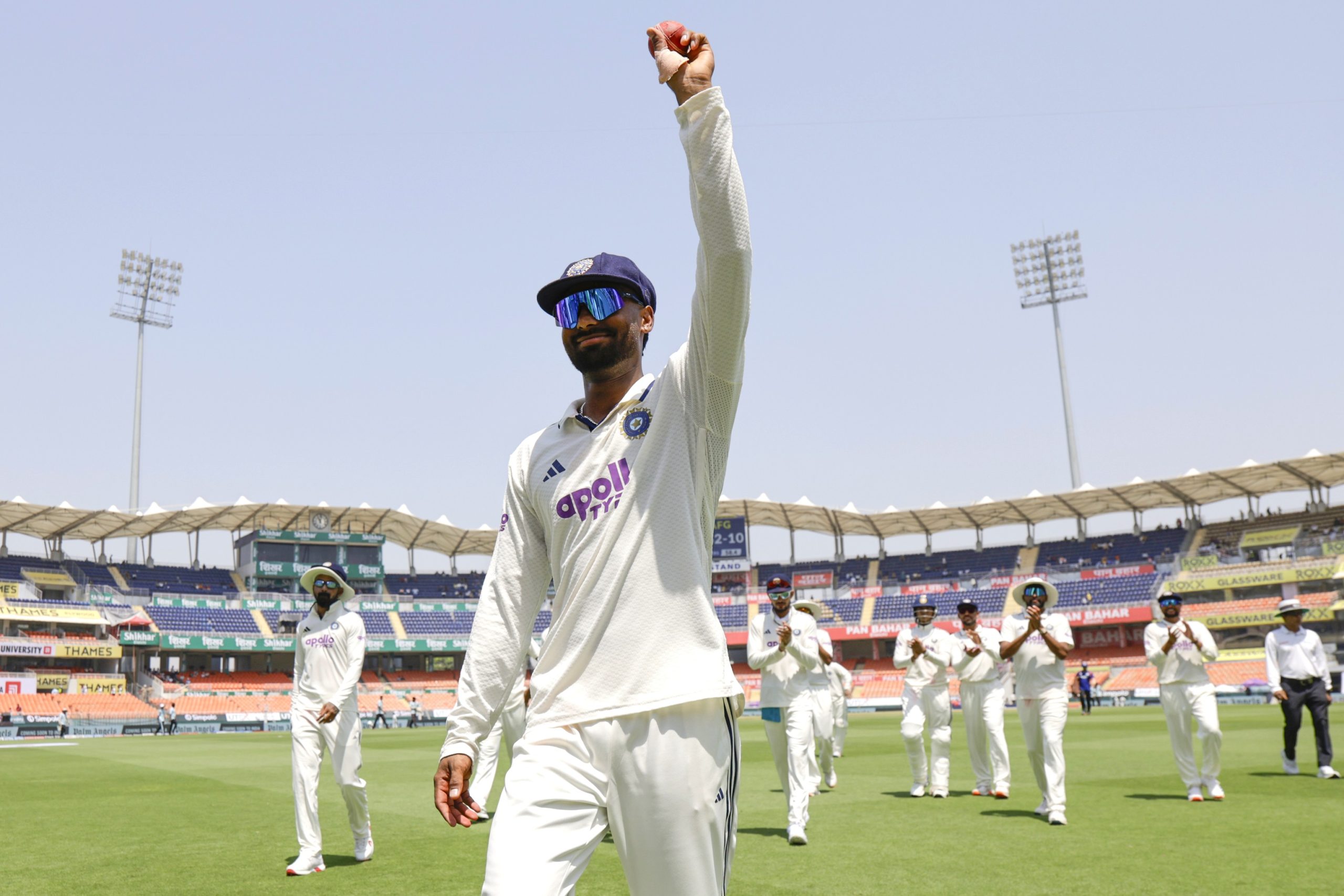
Over a long first spell, Suthar consistently delivered the spinner’s holy trinity: drift, dip, and turn. Rahmanullah Gurbaz and Afsar Zazai fell to a combination of all three. A pitch that hadn’t developed cracks or dark rough patches was generating substantial turn off Suthar’s bowling. On Day 3, Suthar sent another one swerving across the eyeline, this time to the well-set and solid Rahmat Shah, again coaxing a sweep, and hit the timber. It was a fitting way to complete a fiver on debut.

Afghanistan were already crumbling. They were bowled out for 152, 412 runs behind India. Suthar finished with 6/33—the second-best figures by an Indian debutant, behind Narendra Hirwani’s eight-wicket haul against the West Indies in 1988. If the first innings was brief, Afghanistan’s second innings went by in a flash, lasting a mere 35.5 overs. Suthar was given the first over, and he almost got a wicket. This innings, though, belonged to Kuldeep Yadav and Washington Sundar, to whose bounce and turn the Afghan batters had no answer to.
The winning margin of innings and 300 runs was India’s biggest ever in Tests. And although many might look at Afghanistan’s inexperience with the red ball and the absence of Rashid Khan, India had a weird pressure of executing a good match. This was the first match of a new cycle, a restart, so to speak, after a tumultuous period at home in the last couple of seasons. They came to New Chandigarh needing a little more than just a victory.
India’s next Test is another couple of months away, after a round of white-ball games at home and then in the UK. And while Sri Lanka will come with a whole palette of questions, India will do well to remember the application from this Test match. And they’ll do well to make a proper Test all-rounder out of Manav Suthar, who should now, fitness permitting, be in every squad going forward.


