

The ongoing ICC Women’s World Cup is slated to be one of the most exciting editions in the history of the tournament. There is genuine enthusiasm about which team is going to walk away with the trophy, since the associate nations are becoming more competitive more often.
Scotland have been one of the emerging nations in both the women’s and men’s games for the last five years. They have been helped by their women’s players competing as professionals in England, which has opened the doors for the youth in Scotland.
There is now a clear regional pathway in place that identifies talent, and with their Under-19 teams participating in World Cups, cricket is finally a legitimate career path for aspirants in Scotland. As a nation, they can no longer be taken for granted.
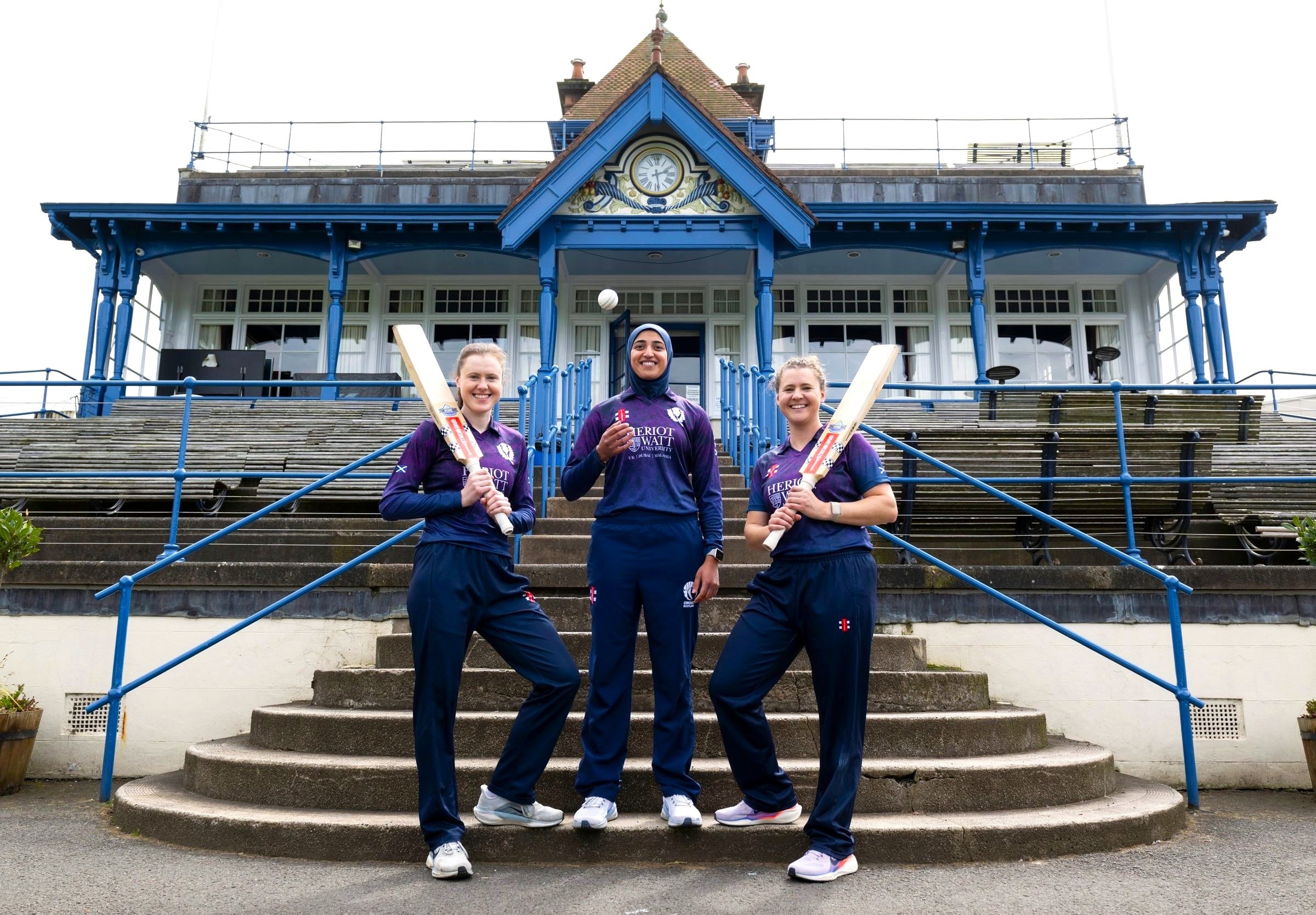
With Scotland starting to become a part of top-tier events, it feels they are no longer just lucky to be at the top table and have earned their place. As Kirstie Gordon said at The Blaze media day back in April, ‘’There is so much positivity around, that rather than it just being happy to be there, we want to make some big statements.’’

That isn’t just the usual pre-tournament hype you get from players. There is substance to back up Gordon’s claims. That is partly because of a decision that she made eight years ago to play for Loughborough Lightning in the Kia Super League, which made her ineligible for Scotland since, at that juncture, ECB rules didn’t allow Scots to play professionally in England while still playing international cricket.
By qualifying for England to become a local player in the Kia Super League and subsequently featuring at the 2018 T20 World Cup as well in the one-off Test match against Australia in 2019, Gordon exposed the limitations facing ambitious Scottish cricketers. Subsequent changes to eligibility rules in ECB competitions widened access for Scottish players and created opportunities for the next generation, including Kathryn and Sarah Bryce, to develop within the English domestic system without having to switch allegiance back to the native nation, like Gordon did in December last year.
It’s a fact that her Blaze and international teammate Sarah admits. “Gordon set the foundation that allowed us to be able to do what we do now and be able to play in the domestic setup in England, and that she had to make a big sacrifice to ultimately allow us to do this.’’
Since then, most of the Scotland squad named for the T20 World Cup 2026 have played regional or county cricket in England as professionals, including Darcey Carter, Katherine Fraser, Rachel Slater, Priyanaz Chatterji, and Abtaha Maqsood, who has unfortunately fractured her hand. Even Gabriella Fontenla, the 18-year-old fast bowler, is part of the Yorkshire academy.

It is a happy headache for Scotland Head Coach Craig Wallace. ‘’The depth we have now to choose from is incredible and every selection is enjoyable, but really tough. I think we’ve got a really good balance in the squad in terms of what we think we need to succeed in the tournament. We have multiple world-class players in this team.’’
Plying their trade south of the border, Scotland are reaping the benefits of England’s advanced cricketing ecosystem. As Kathryn points out, ‘The knowledge and understanding of one’s own game improves, and the players are tested under a lot of pressure.’’
The county system has the benefits of backroom staff and the ability to analyse performances they would not have to the same extent in the Scottish system. The recent tri-series against the Netherlands and Bangladesh in Edinburgh was the first home series for Scotland in four years.
With county competitions in England attracting overseas players such as Meg Lanning and Jess Jonassen, exposure to that calibre of cricketers can only raise standards. The wealth of experience they bring, combined with the golden chance to observe how they prepare and approach the game, provides invaluable guidance for youngsters.
That first #T20WorldCup win feeling 💜 pic.twitter.com/HnXfcFGPOr
— Cricket Scotland (@CricketScotland) June 13, 2026
While Scotland haven’t had many bilateral series of late, unlike the extensive programme enjoyed by Full Members, they have had regular qualifying tournaments.
The lack of an international itinerary has previously led some senior players to consider pursuing opportunities elsewhere, following in the footsteps of Gordon. However, the qualification events are worth their weight in gold, ensuring the squad is getting a taste of international cricket.
‘‘It’s been a great winter, with the Emerging Nations Trophy in November, and the World Cup Qualifiers in Nepal,’’ Sarah said at the start of the season. ‘’We have had that time as a group, as a Scotland team, to gel and play more games collectively, which is not always the case.’’
That showed in their recent win against Bangladesh that a settled core is forming. Leader Kathryn has a calming presence. The type of captain who leads from the front, Kathryn is in charge of a young group of players, six of whom have represented Scotland at the last Under-19 World Cups, with Chloe Abel the solitary exception.

Born in Hobart, Abel decided to play club cricket in England in the summer of 2023. Both Middlesex and Scotland spotted her, and the latter was able to bring Abel into the international team. It proves that for a small cricketing nation like Scotland, they can spot talent that isn’t exclusively going through their pathways.
While individuals can be slotted in, it feels like Scotland are building a team that will be around for a while. Gordon highlights, ‘’I can see the future of this team going very far together at World Cups to come. This is just the beginning.’’
Players like Fraser and Rachel are now experienced cricketers despite being 21 and 24, respectively. Fraser made her debut for Scotland at 14, and while that is unusual now, she has been a regular feature of the Scotland side since then and is closing in on fifty T20I caps. In the process, she has led the Under-19 Women’s T20 World Cup 2023 squad. Sarah notes that Fraser has ‘‘come of age, with bat and ball, opening up top.’’
Fraser, who bats for Durham in their lower middle-order, plays a different role for Scotland. Walking out to open with Carter, she made her first T20I fifty from 41 balls in a convincing nine-wicket victory in their series opener against the Netherlands.
It is why it feels like Scotland are ready to take on the world’s best in the T20 World Cup, and while it is in England it is right on their doorstep.
Are you ready to Catch the Spirit?! Pure action and excitement await at the #T20WorldCup ⚡️
You won’t want to miss this! Get your tickets here 👉 https://t.co/2gs3Yzdsmi pic.twitter.com/G56OfXrWes
— T20 World Cup (@T20WorldCup) June 12, 2026
With England and Ireland in their group, it will be an exciting one for players and fans. Sarah knows that the experience of playing in England will help. ‘’A lot of players will have played at Headingley (the venue for their game against England) and will have played against a lot of England players. So it takes a little bit away from the fact that you’ve never played against these people before.’’
An edgy factor for Sarah is that ‘’Scotland versus England games, whatever the sport is, are always exciting.’’ Kathryn echoes the sentiment. ‘’Just standing there for the anthems, it’s a really special moment.’’
It won’t be the first time that Scotland meet England at a T20 World Cup, having lost to them by ten wickets in 2024. That will be one of the driving moments to perform better this time around.
Scotland are in a group where, while they won’t take any team for granted, they know they are capable of surprising a few people by winning games they wouldn’t have thought possible in the past.
A #T20WorldCup triumph Scotland will cherish fondly 👏
Revisit the highlights from their win over Ireland 🎦: https://t.co/WqX1NmmPtt pic.twitter.com/obVnBpKbhx
— T20 World Cup (@T20WorldCup) June 13, 2026
Last year, they beat West Indies in Lahore in an ODI World Cup Qualifier by 11 runs, despite the best efforts of Hayley Matthews.
Recent wins against Bangladesh and the Netherlands show that results against nations that they have been on the disappointing end of are starting to turn into wins.
They have started their campaign promisingly against Ireland, their frequent foes. Ireland went down the full-member route courtesy of their men’s team, and while they are still strong against associate sides, they have seen their opportunities for games against the other full members go down. Which, weirdly, has benefited Scotland.
There is also a lack of external pressure outside of cricketing circles. It is perplexing that more people aren’t picking up on what a good side this could be. Without media scrutiny in Scotland, though, it means that there isn’t an axe dangling over their heads, unlike other nations in the competition.
‘‘I think we’re very well prepared. The team feels like it’s in a good space, so we just want to play our best cricket and see what happens with no expectations,’’ Gordon reiterates.
Without that pressure, they can go out and play their natural game. A bad performance won’t change the expectations of the team. Something that the hosts won’t get away with if they perform below their high standards.

There is no doubt that this is a Scotland team with talented players, but their wherewithal to deliver the goods consistently against the bigger nations remains to be seen. They also have New Zealand, the current holders of the T20 World Cup, and Sri Lanka in their group. If they can execute their skills uniformly, there is no reason they can’t cause a few scares in the camps of teams at the upper rung of the ladder.
It is not just the stalwarts who have been playing at the top-flight level that could come away from this tournament with new fans. Scotland have a young fast bowler in Gabriella Fontenla, who, in her first T20I series, impressed with 1/11 against Bangladesh from her allotted overs.
Gordon is among her many admirers within the contingent. ‘’She just runs up and bowls quick, and at that age with no sort of previous traumas, just goes for it.’’
Scotland will be looking for that sort of attitude from their young guns. It can be past experiences that hold back players who have been around the block more often. If anything, what this group represents is a shift in expectation. Scotland are no longer content with simply being part of the occasion; they believe they belong there.
The foundations are well-established, whether through professional exposure, a settled core or a pathway that continues to produce talent. There will still be moments in which they are put under the pump, particularly against the powerhouses, so composure will be their friend.
Yet, with a squad that has grown together and increasingly understands what is required to excel at this level, they arrive at this World Cup better prepared than any Scotland side of the yesteryears. What comes next may not be predictable just yet, but it should no longer be a surprise.


