

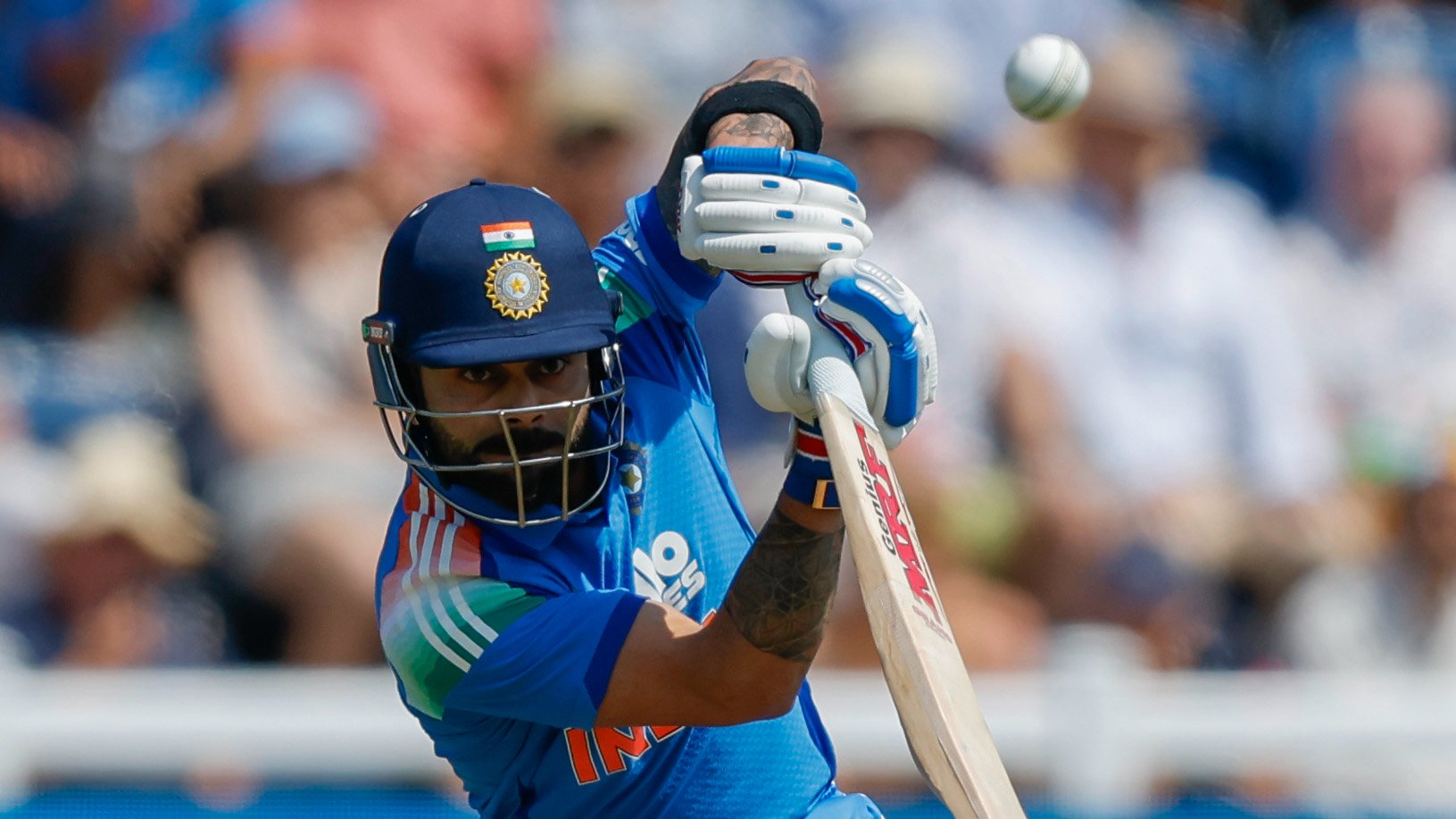
The spectator stand opposite the pavilion at the Sophia Gardens in Cardiff went from ringing out chants of “Kohli, Kohli” to “Bumrah, Bumrah” in a span of half an hour. Before you jump the gun and think that each of India’s national treasures were being appreciated for their respective skill-sets, let me clear the fog. While a switched-on Virat Kohli’s positive intent got the crowd going, Jasprit Bumrah had actually pulled off a mighty impressive hook shot to consign Saqib Mahmood to an 18-run over. Having shown his wares against Stuart Broad in the record-breaking environs of Edgbaston, the senior figure remained unbeaten on 20 as India tumbled from 178/3 to 233 all out.
Towards the end of that nosedive Jofra Archer was hellbent on targeting the ribcage of Gurnoor Brar, in whose batting ability Shreyas Iyer put more faith than necessary. Instead of farming the strike, he exposed the new kid on the block to thunderbolts that had already swallowed the likes of Kohli, Shivam Dubey and Axar Patel, who chaperoned India home alongside Washington Sundar the other day. Yet a spasmodic innings meant England drew the series level ahead of the horn-locking at Lord’s, where a report from an esteemed publication suggests Rohit Sharma might play his final game for India.
The selectors apparently want to groom Yashasvi Jaiswal for the opening role come ODI World Cup 2027, and the unheard concept of white-ball rhythm eluding Rohit, 39, becoming a reality may have just accelerated the transitioning process, if true. Scalped by Sam Curran in Birmingham, he played a maiden versus the left-arm virtuoso as India jostled to gain an unassailable lead. It was the worst possible time to discover fluency owing to the exit of Shubman Gill, a casualty at cover following a spate of bottom-handed whips. The barren patch grew to nine dots eventually, leading to a toe-edged sweep after Will Jacks denied Rohit the breathing room he was desperate for. It is a separate matter that the all-rounder himself felt the pinch with England’s chase in its climax; the approach to hit his way out of trouble not landing well with anchor Joe Root.
“See I have played a lot of cricket, seen a lot of cricket, on a day there are a lot of batters I have seen they don’t get that momentum they are looking for. And that can happen,” Indian batting coach Sitanshu Kotak said about Rohit’s 46-ball 27. “Maybe the shots he normally plays, like on-the-up, he did not get to play which is because of the double bounce,” he added, referring to the two-paced nature of the wicket, evident from the dismissal of Ishan Kishan. He was through the pull shot early, offering a return catch to an exuberant Curran.
“The fuller deliveries were coming onto the bat nicely but the back of length ones, in the first innings, were stopping in the surface. Even in the second innings the short balls weren’t climbing as such, but definitely lost their pace to an extent upon pitching.” Kotak elucidated. “It wasn’t a straightforward ODI wicket,” Root echoed his sentiments after scoring an unbeaten 99 off 133 balls to navigate an arduous pursuit.
Jofra Archer brought back and he gets the big wicket of Virat Kohli 👊 pic.twitter.com/ZM1yagSSVO
— England Cricket (@englandcricket) July 16, 2026
If England struggled with an ask of 234, what could’ve been the case had India converted either of their three partnerships worth fifty and thereabouts among the top five? Holing out to third man, Kohli perished on 65 to a cross-batted flick barely conducive to the misbehaving track while Iyer, another half-centurion, left India in the lurch when an explosion was very much the need of the hour. “I thought it was a phenomenal effort,” skipper Harry Brook credited his bowlers. “They were 170/3 after 30 overs and looking like getting a big total. Then to bowl them out 7 for 60 in the end was ridiculous.”
His counterpart was equally astonished. “Quite disappointing, to be honest with you. We thought 300 would be a good total after 25 overs, but we lost too many wickets in the middle overs,” Gill remarked. “I think we expected a bit more from our lower middle order and we were not able to capitalize on the start that we got. But hopefully, the next time we get there, we’ll try to build some small partnerships and take it on from there.”
It is a tough pill to digest because of the advantageous position India squandered. Enjoying a purple patch in the format, Kohli was flowing as serenely as River Taff. He leapt out of the crease to thump Gus Atkinson over mid-on, exhibited the wristwork he is renowned for by cutting and slog-sweeping Adil Rashid, and punched Curran down the ground with elan. The leg-spinner was set to thrive on a sticky strip, for a hint of grip and bite adds to the potency of his revolutions, but Iyer flexed his muscles to unsettle the attacking option. Facing his first ball from Rashid, he went inside out and later used his feet to clear long-on, a tactic he employed successfully in the weeks gone by as England’s fire-breathing speedsters left India with no choice but to target the quota of spin.
In the same vein, pace accounted for nine of the ten Indian victims even as Iyer’s improvement on the short-ball front stood out. “I thought they were brilliant today,” Root complimented the quicks. “We found a way to get something out of the surface. Sometimes, when you’re batting second it can be quite difficult to gauge what a good first innings score is, especially when you have the best player to have ever played this format out there and getting a run-a-ball fifty. But that’s the art of it, and credit to our bowlers to keep finding ways to get wickets, for stalling and not allowing them to form those partnerships and consolidate their total.”
Another superb knock by Joe Root that fell agonisingly short of a century in England’s win over India in the second ODI 👏
Full scorecard 👉 https://t.co/wvBFKkqFCE pic.twitter.com/k7KXhvR3Rs
— ICC (@ICC) July 17, 2026
The diaspora roared “Bumrah, Bumrah” again, for his stronger suit on this occasion, when his away-seamer sent Ben Duckett packing for a golden duck. Alas, despite the support of the crew, to the point that no boundaries were conceded in eight overs during the middle phase, India head to the home of cricket with the battle on an even keel.


