

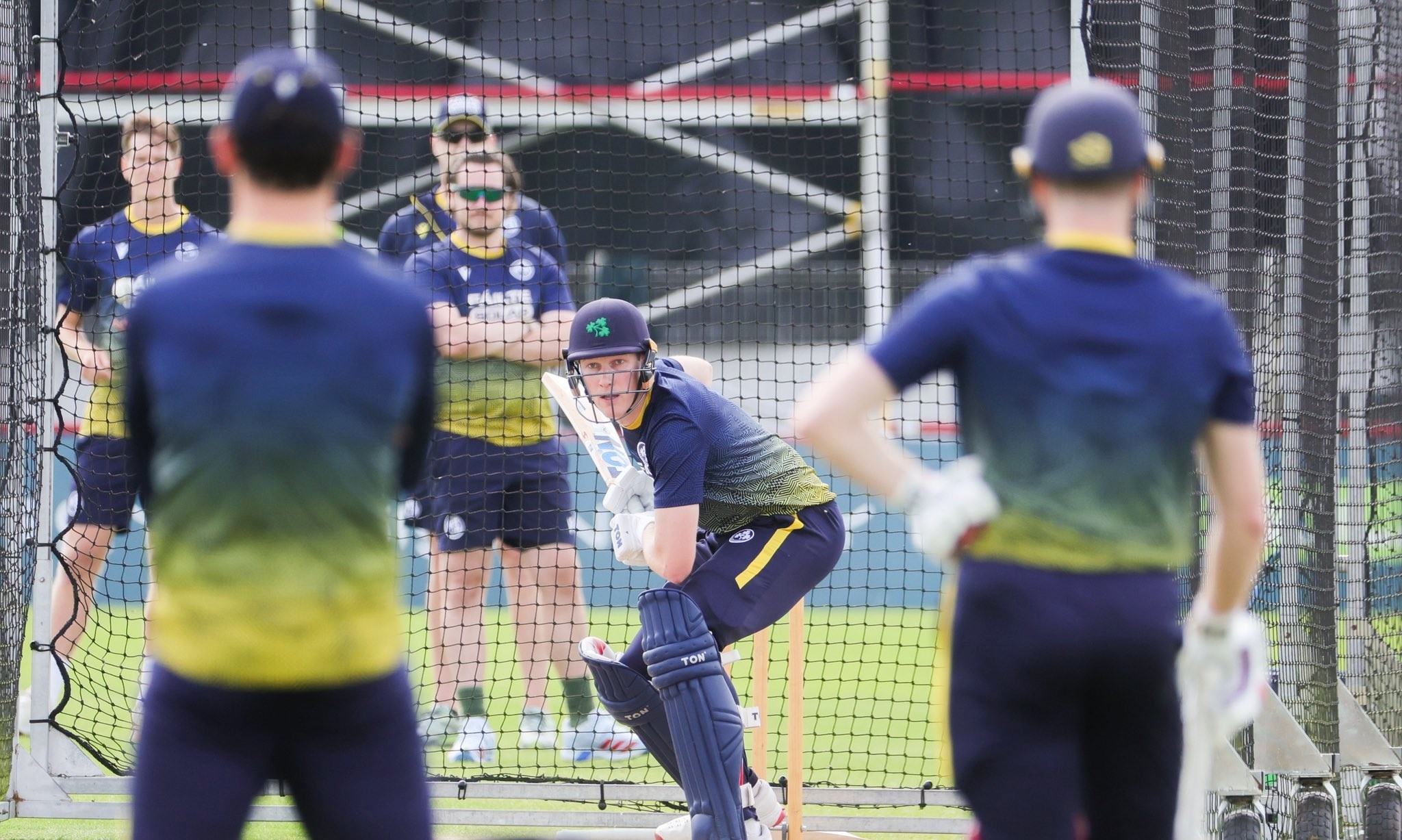
Ireland Wolves, the feeder unit to the senior side, have toured the subcontinent five times since their inception in 2017. Back then, Afghanistan engaged in white-ball action with the boys in green at Greater Noida. More recently, Ireland were protagonists of the 2026 T20 World Cup, an event jointly hosted by India and Sri Lanka, who played a two-match Test series at Galle with the Irish back in 2023. The United Arab Emirates welcomed Ireland to the Gulf this January in what was an acclimatization drill for the marquee event. As a cricketing nation Ireland have received more than enough exposure to spinning conditions, yet their technique and temperament against the slower bowlers belies the knowledge gained from multiple trips to Asia.
The just-concluded ODI series versus Afghanistan was littered with examples of their ineptitude facing spin, and all the more telling was the fact that the seasoned campaigners looked at sea. While cutting a spinner off the backfoot coaches recommend that the batter’s upper body should go towards the ball in order to generate force into the shot. His feet glued to the crease, Andrew Balbirnie reached out for Rashid Khan’s leg-spinner with his hands per se only to nick behind. Harry Tector, having earned 168 caps, wasn’t able to read the googly out of the virtuoso’s hand. It took merely three balls for AM Ghazanfar to trap Paul Stirling in front, surprising the bulwark with his skiddy trajectory.
In the third ODI, Ireland lost 7/65 in the middle phase. Rashid and Ghazanfar picked 18 of the 30 wickets to fall in the three ODIs they both featured in. The senior pro, especially, resembled a panther on the prowl during his delivery stride. He could sense blood, well aware that Ireland are at their wits’ end figuring out his variations and air speed. “Here you get the sharp spin which I really like, especially in these conditions. More importantly the challenge was hitting the right areas consistently. That’s something I was focussing on. Length of 5 to 5.5 meters, bowling into the stumps, brings you into the game. As a spinner I feel you just need to keep things simple, hit the right area on a good length. Keep mixing it up. Leg-spin, wrong ‘un, flipper – but more important is the length. Make sure it’s finishing into the stumps. Keep it simple and keep enjoying your magic,” Rashid elucidated.
Common sense is the last resort in the negotiations with an in-form bowler. Mark Adair, who debuted for Ireland in 2019, swung for the hills to hear the death rattle when application was the need of the hour. Such was Rashid’s stranglehold that Stirling reckoned his absence offered Ireland the ideal opportunity to sneak in a semblance of glory. “I thought that no Rashid Khan made a huge difference today, and I thought that was probably our best chance to pip them,” he reflected on the fifth ODI which Rashid was afforded rest for.

It’s not unusual for spin to prove a thorn in the flesh of western sides. Between 30th May 2019 to 31st January 2025, England’s batting average of 35.87 was the lowest among the top teams, indicating that their batters struggle to build partnerships and frequently crumble against spin. The most damning assessment in that regard came in ODI World Cup 2023, where England lost 8 wickets to spin against Afghanistan in Delhi, setting a record for the most spin-inflicted dismissals they had ever suffered in a men’s ODI World Cup fixture. Earlier that year, England copped a whitewash at the hands of Bangladesh in the three-match T20I series – recording scores of 156/6, 117 all out and 142/6 – besides folding for 196 in the final ODI at Chattogram.
Foreign batters grow accustomed to the ball zipping off the deck, so miscues are par for the course when the ball sticks into the surface to lose pace upon pitching, a hallmark of subcontinental strips featuring black soil as an ingredient. However, there have been flashes of brilliance from the England camp when it comes to handling the grip and bite, and on most occasions the refreshing result boiled down to the groundwork done in conjunction with a subject matter expert.
Dinesh Karthik joined the England Lions coaching staff as a batting consultant during their tour of India in 2024. He spent nine days in Ahmedabad grooming the Lions for their multi-format series against India A. The first knock that came out of an English batter’s willow on that assignment was Keaton Jennings’ 154.
In his autobiography, Kevin Pietersen revealed an email conversation with Rahul Dravid, whose advice he sought on dealing with spin. Applying those learnings – prevention of premature commitment on the frontfoot, keeping the bat in front of the pad, making peace with plays and misses – made a world of difference to his career.
On his maiden tour to India, with the Australia A team in 2018, an eager Marnus Labuschagne trained under Sridharan Sriram to iron out his flaws against spin. Sriram helped prepare the appropriate tracks and devised plans to bring the sweep shot into the equation to get Labuschagne ready. In his first trip to the crease, the right-hander added 114 with Usman Khawaja from a precarious position of 90/4, not only being assured in defence but also using his frontfoot stride effectively to drive Kuldeep Yadav thrice via covers.

“He’s always with his iPad or laptop, looking at videos and planning for the next game, the next scenario,” Malolan Rangarajan, talent scout at Royal Challengers Bangalore, told Cricinfo about Sriram. Video analysis has become an integral part of a modern batter’s toolkit. As per conventional wisdom reading a spinner off the pitch shaves an extra second off the decision-making bandwidth, hence the pre-match dissection to earmark visual cues. Shimron Hetmyer, annoyed by the wily Maheesh Theekshana earlier this year, studied zoomed-in footage to troubleshoot. In a lateral inversion of that process, Ashwin outwitted Steve Smith and Labuschagne in Border Gavaskar Trophy 2020–21 by famously utilizing a middle-and-leg stump line.
Ireland have been involved with performance analyst Scott Irvine since 2014, for the record. He took to LinkedIn after the humbling 4-0 sweep. “Understandably some rust after 15 months with no ODI cricket, but plenty for us to take away from games against a strong Afghanistan side, packed with experience and match-winners.”
“More importantly, the series gives us a clear picture of where we need to improve at the beginning of a really exciting six-month period for this group in 50-over cricket. The focus now shifts to continuing to build and refine how we want to play in this format, gearing up for the World Cup Qualifiers in early 2027.”
There is an Ireland Wolves tour scheduled for Zimbabwe, one of the three Southern African nations which will host the ODI World Cup 2027 that Ireland aspire to attend. In 2023, Gudakesh Motie took full advantage of the spin-friendly conditions at Queens Sports Club, enjoying career-best figures of 7-37 in 14.5 overs. Before that, Harare Sports Club witnessed Mosaddek Hossain’s fifer against Zimbabwe in the shortest format. The host nation is girding up its loins at Omtex ICWC institute, with the women’s team and U19 boys availing the facilities in Saphale and Jaipur respectively. Cross-conditional playing experience for 18 days will hold the Chevrons in good stead against spin, and Ireland must pluck a leaf out of their book to conduct more targeted exposure stints in the subcontinent. Simply put, to become the best, learn from the best.


