

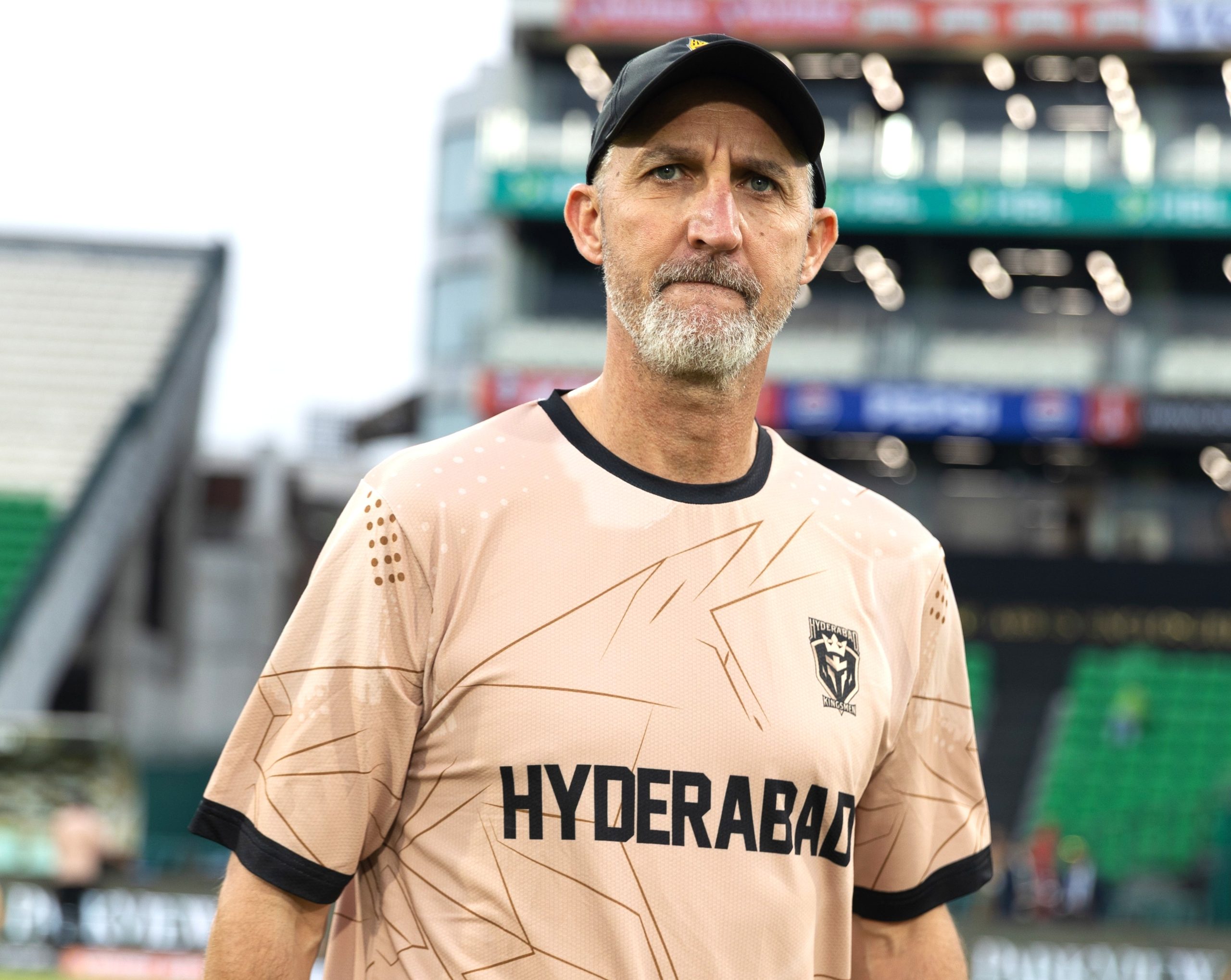
Life has come full circle for Jason Gillespie within the Pakistan cricketing ecosystem. The Australian fast-bowler turned coach was drawn into the whirlpool that is their national administration, and as it usually happens in that part of the world as far as professional relationships in the top brass are concerned, things got ugly.
Gillespie was left feeling ‘’completely and utterly blindsided’’ by his employer, however the synergy he sought from the top echelons was ultimately provided by a franchise in their inaugural season. Call it the lack of baggage or just plain ethics, but Hyderabad Kingsmen valued what he brought to the table, and in turn, were catapulted to the top of the PSL table.
There was a lot of expectation surrounding Gillespie when he was named as Pakistan’s Test coach in April 2024. With Gary Kirsten set to guide the team in the 50-over format simultaneously, it looked like the duo’s in-tandem appointment would usher the country’s cricketing sun back out from the darker clouds hiding it.
“Jason’s coaching career has been marked by success both at the domestic and international levels, with a focus on player development and achieving excellence in team performance,’’ PCB Chairman Mohsin Naqvi enthused. He also proclaimed that the board is committed to support Gillespie in the pursuit of their shared vision to unlock Pakistan’s full potential.

In the following months, Gillespie seemed to be substantiating the expectations placed on him. Under his guidance, Pakistan won a home series against England, the sweet taste of triumph following six consecutive Test defeats. This victory also ended Pakistan’s joint-highest winless streak at home: 11 matches – 7 defeats and 4 draws.
However, Pakistan was not really winning off the field. Gary Kirsten, the architect of India’s triumph at 2011 ODI World Cup, relinquished his white-ball coaching role six months into his contract without having overseen Pakistan in a single ODI. ‘’The thing that surprised me more than anything was the level of interference. I don’t think I have ever seen it at that level before,’’ Kirsten alleged.
“It is quite difficult for a coach to come and formulate a way that you can work with the players when there is just this constant noise from the outside and a lot of punitive actions around poor performance.’’
“As a coach, you are the lowest hanging fruit when the team isn’t going well, so let us get rid of the coach or let us put a restriction on the coach because that is the easiest thing to do when the teams are performing and that is kind of counterproductive in my view,” Kirsten lamented.
His departure in October 2024 saw Gillespie fill the big boots on an interim basis. He led Pakistan to a 2-1 win against Australia, their maiden series conquest Down Under in 22 years.

As the green shoots began to bloom, Pakistan, staying true to themselves, self-sabotaged. Gillespie too had an unceremonious exit, miffed by the PCB officialdom. In December 2024, he put in his papers, terminating his two-year contract barely eight months into the job.
“There were certainly challenges. I went into the job eyes wide open. I knew that Pakistan had cycled through a number of coaches in a pretty short space of time. The straw that broke the camel’s back, I suppose, was, as a head coach, you like to have clear communication with your employer,” Gillespie rued.
The ouster of high-performance coach Tim Nielsen wasn’t appreciated by Gillespie, who was neither informed of this development nor consulted with as a member of the leadership group. “I tasked him with working closely not only with our batters, but with our fielding and our wicketkeeping. We out-fielded England in a Test series, and not many Pakistan teams can claim to out-field an opposition,’’ said Gillespie, incensed by the removal of his assistant and the lack of selectorial say as executives ran the show, sidelining the subject matter expert.
The back-and-forth between the 51-year-old and his recruiter carried on for a while, with questions swirling around what the former was owed financially and whether he followed the protocol laid out in his initial contract regarding notice period. A little over a year after the noise around this fracas dimmed, Gillespie the head coach returned to Pakistan. The member of the Australian World Cup teams of 1996 and 2003 joined Hyderabad Kingsmen ahead of 2026 PSL.
The minds behind the mettle 🧠 pic.twitter.com/QrR4qCdgDs
— Hyderabad Kingsmen (@HHKingsmen) March 24, 2026
Owned by Fawad Sarwar, a Pakistani-American businessman who also owns a T20 side in Chicago, Hyderabad Kingsmen was a new entrant to the league’s roster, alongside Rawalpindiz.
Trumpeting Gillespie’s appointment, the team shared on X, “Vision clear. Direction locked. Entering a new era. Jason Gillespie takes charge as head coach of Hyderabad.” He responded in kind. “I’m very excited to be part of the Kingsmen team. Lots to look forward to and I can’t wait to get started!”
This time around, with no bureaucratic albatross around his neck, Gillespie went about his business methodically. He first structured his coaching team as per his desire, roping in Craig White and Grant Bradburn, whose appointment was strategic given his wealth of experience in the Pakistan circuit. He worked as a fielding coach with Pakistan from 2018 to 2021 and was the head of High Performance Coaching at the National Cricket Academy in Lahore. Later, he also became Pakistan’s head coach from May to November 2023.
As it turned out, in an illustration of poetic justice, Hyderabad Kingsmen reached the PSL final in their inaugural season, losing to the well-established Peshawar Zalmi who collected their second trophy. The podium finish, considering how they started out their campaign, made for a moving story. They lost four consecutive matches to begin with before turning a corner to win seven of their next nine. When the chips were down, the athletes were subjected to a shot of adrenaline from boss Fawad.
‘’The comeback will be legendary,’’ he roared during a pep talk.
Right on brand with Gillespie’s vocation, the resurgence was fuelled by their new-ball merchants. Struggling to fetch PowerPlay wickets initially, Hyderabad Kingsmen became the best bowling unit inside the circle after the quartet of defeats.

From the fifth match onwards, Hyderabad Kingsmen took most PowerPlay wickets (19) and had the best average (24.5) and economy (8.65) among all teams, an improvement by leaps and bounds given the figures hitherto – 82.6 and 10.3 respectively. In the first four matches, Hyderabad Kingsmen used around 60.4% spin in the PowerPlay; henceforth it came down to 36.4% as Gillespie championed his own tribe.
From the cadre of speed merchants, Hunain Shah was a revelation. He warmed the bench in the initial three games, but Gillespie brought him into the fold in favour of overseas gun Riley Meredith who had taken five wickets in three games at an alarming economy of 10.63 runs per over.
The idea was to strengthen bowling at key junctures, such as the death, on pitches that revived Babar Azam’s T20 career. Hunain nailed his yorkers, ensuring Kingsmen had the second-best economy rate (10.40) and took a wicket every 7.80 deliveries in the slog overs after four defeats. Notably, they also bowled 34.8% dot balls, the third-highest.
Hunain formed a lethal old-ball partnership with Mohammed Ali, both picking eight scalps each at the death. These nifty manoeuvres showcased Gillespie’s ability as a coach, something that the powers that be could not recognize in the past. Take, for instance, the usage of Kusal Perera in the middle order.
From 2025 to the commencement of PSL 2026, the explosive left-hander had batted only thrice outside the top four in 36 innings. Still, Gillespie gambled, playing Perera out of his preferred positions. It worked like a charm, for the pocket dynamite was the third-leading run-getter among batters walking out at No.5 or below in this edition.

209 runs at an average of 34.8 and a strike rate of 149.2 in eight outings, with two fifties, was evidence that he passed the test with flying colors. Gillespie’s move was tactically astute because Hyderabad Kingsmen got a southpaw in the middle order to break the monotony of right-handers in Usman Khan, Glenn Maxwell, and Irfan Khan.
Perera handled wrist spin with consummate ease, negating the threat of the tweakers to protect finishers Maxwell and Irfan. He scored at a strike rate of 148.7 and hit a boundary every 6.5 deliveries against wrist spin. Since their first win of the PSL, Kingsmen scored 502 runs between the end of the PowerPlay and the 14th over, more than any other side. Usman Khan was Perera’s partner-in-crime during these middle-phase onslaughts, giving a much better account of himself in PSL as compared to internationals where his strike rate is an anchorish 121.8.
Another standout feature of Gillespie’s man-management was related to uniformity. He developed a settled eleven, backing the ideal combination to deliver the goods. From the fifth match onwards Hyderabad Kingsmen used just 12 players, the fewest among all teams, despite playing more matches (9) than any other side in the second half. In contrast, they’d recycled as many as 16 in the first four.
“We trusted the players to step up and do their job when it was required,’’ Gillespie stated. ‘’We kept it as simple as that. We kept the vibe around the dressing room really positive. Our mantra was being calm, being clear and just to execute our skills.’’

As Hyderabad Kingsmen defended six in the last over to clinch the semi-final, the stage was set for a perfect redemption arc for Gillespie as well as captain Marnus Labuschagne, who has been in and out of Australian squads across formats and was handling his first T20 captaincy assignment. Although the ultimate hurdle could not be crossed due to their untoward record of the lowest first-innings total in a PSL final, it was nonetheless a dream ride for the Australian pair keen to prove a point.
At the PSL 2026 presentation ceremony the skipper of the runners-up, Labuschagne focused on the rear view mirror with pride. ‘’I think tonight hurts, obviously, but reflecting on what an amazing season and what a tournament we’ve put together, coming from four losses down to winning four in a row, getting bowled out for 80, then winning by a hundred, and then winning two games to get into the final. We’ve made so many great memories. I’m just so proud of the team, and it’s been an awesome effort.’’
Labuschagne gushed about the co-operative atmosphere in the Hyderabad Kingsmen camp having authored a fresh chapter of his professional journey, that of a T20 talisman. ‘’Was really excited about the opportunity and got to challenge myself in a different environment. I’ve just really enjoyed getting to know the players, the owners, the support staff. It’s really exciting to see what this team has built in such a short period of time, and hopefully there’s some really amazing things to come.”

Gillespie sang from the same hymn sheet, commending the bouncebackability of his boys. ‘’In this tournament, we’ve found ourselves in tricky situations and found ways out of it. I’m incredibly proud of the players and what they’ve achieved. We were written off very early in the piece and they stuck to the task.’’
‘’We were training well, preparing well, and our strategies were all sound. Once we got a win, that started to build a bit of confidence around the group,’’ Gillespie highlighted.
Keeping the nose to the grindstone, Hyderabad Kingsmen have made an instant splash. Behind the franchise’s fine headstart is an Australian mentor who was ostracized not a long time ago, in this region itself, supposedly by those designated to enable his methods. That, in a nutshell, tells you why Pakistan has always been a cricketing nation that takes one step forward and two steps back.
*with statistical inputs from Darpan Jain


